
This article is a primer to the concept of Grace +Truth and the core ideas behind this blog.

A dilemma
I used to live in Kings Cross and belonged to a local church which met each Sunday evening.
I got to know a man, who I’ll call Ian, who occasionally came to the church. He was struggling to overcome a crack addiction and was trying to find work as a painter and decorator. One evening he turned up at church having just been thrown out of his accommodation after a row with his partner, and he had nowhere to go.
At the time I was manager of a hostel for homeless young people in Soho, so I wasn’t naïve and knew a fair bit about addictions and homelessness. In my work context, I had clear boundaries, but this was church. Ian was not someone I was contracted to help, he was a fellow member from my local community.
At church, we read scriptures and sang songs that pledged radical generosity. What did that mean faced with Ian having nowhere to stay?
I told him he could stay with me while he sorted out somewhere to live.
Unravelling
It went OK for a few days, but Ian struggled to do anything we had agreed about finding accommodation. Then things started to unravel fast.
One evening, he brought a group of the most chaotic people imaginable from Kings Cross station back to my flat, all with the clear expectation they could smoke crack there. The next day he was arrested, and because he had keys to my flat, the police searched my home. I came back to find a search warrant stuck to my TV. Later, he broke into another church member’s house causing serious distress.
That evening, I had to confront Ian with everything that had happened and the impact of his behaviour. Our church leader joined us, and we talked for a few intense hours. In the end, Ian agreed to hand himself in to the police. I’ll never forget walking with him up the hill to Islington police station at 2.00am.
Of all the ways I tried to help Ian, that talk and walk was probably the most important.
What I learned
I had let Ian stay to show a practical expression of grace. To give him a chance he might not have been offered elsewhere.
But grace alone wasn’t enough. In some ways my offer had made things worse.
Ian also needed truth: about the distress his behaviour was causing, the crimes he had committed, and the mess he was in.
That story basically sums up why this blog exists.
The big idea
How can we best help those who are struggling? How do we combine kindness and wisdom?
I’ve come to believe that grace and truth are at the core of the answer.
Grace is shown in how we accept, affirm and show kindness to others. Truth is shown in honesty and confronting realities. We all need both in our lives.
Grace without truth is naivety and often drifts into enabling negative behaviour. It feels kind but it’s the road to hell paved with good intentions.
Truth without grace can be harsh and judgemental. It may be accurate, but it keeps distance and lacks hope.
The ingredients of love
The challenge and the skill is to hold these two ingredients together. To give another chance and maintain boundaries. To show acceptance and allow consequences. To advocate for their rights and encourage personal responsibility.
It is summed up in this chart which I have shared in countless seminars and talks over the last 15 years:
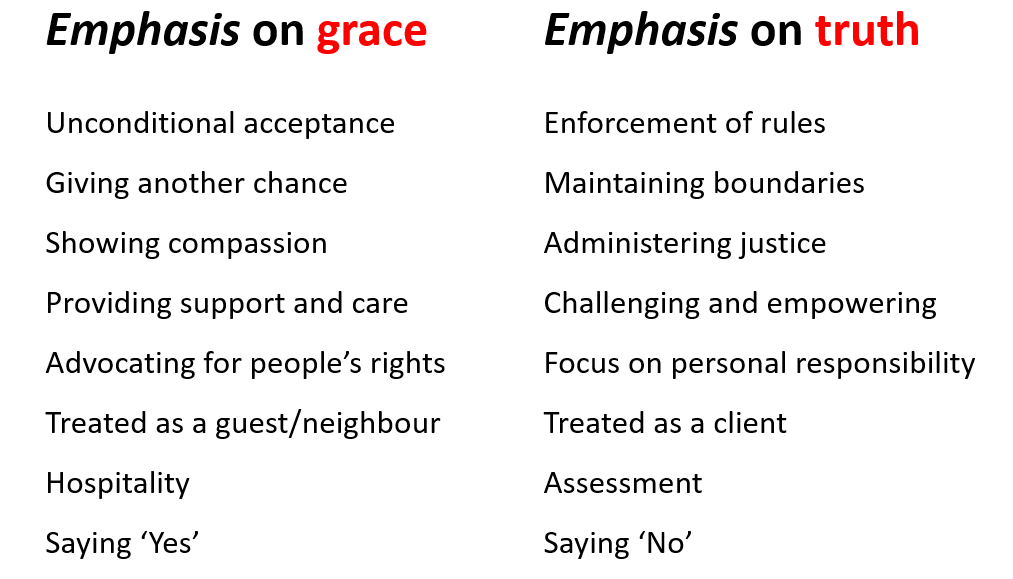
I have come to believe that the reason that grace and truth are so vital is because they are the key ingredients of what we most need: love.
Grace + Truth = Love.
Ancient wisdom
It’s important to say that I have not just made all this up as a clever theory. In fact, all this thinking is rooted in ancient beliefs about how God has revealed himself to humanity.
In the Bible, in the opening of John’s gospel, Jesus is described as being “full of grace and truth” (John 1:14).
It’s a blend you can see illustrated throughout Jesus’ life and teaching as recorded in the four gospels. The most succinct example is when he intervened with a crowd of men threatening to stone a woman found being unfaithful to her husband. When Jesus says, ‘Then neither do I condemn you’, he shares grace. And when he says, ‘Go now and leave your life of sin’, he speaks truth (John 8:2-11).
Wider relevance
These principles of grace and truth have guided and resourced me in my many years working with people affected by homelessness. They have shaped my approach to managing shelters and hostels, leading two organisations and the four years I spent as a government Rough Sleeping Adviser.
Since 2023, I have been immensely privileged to be Chief Executive of Hope into Action, a charity with an award-winning, relational approach to homelessness.
But as well as this context, I also believe Grace + Truth is relevant far more widely: to all our relationships with colleagues, at church, and with friends, family, our partners and children. Having road-tested and shared these principles so much, I believe in them more than ever.
Where to start
Since I started the blog, it has had over 2 million visits. If you are looking for a place to start, then read this series of 3 short posts called Re-thinking Kindness. Most of the articles are around 700 words long and take around 3-4 minutes to read.
Other articles are longer and tackle issues in more depth. An example is the first piece I wrote using this framework in 2011: The Practice of Grace and Truth with Homeless People.
Write for G+T
Whatever your work, interests or beliefs, I hope you’ll find something useful here.
Also, let me know if you want to join the 150+ people who have written a guest post. Just think: what has grace and truth meant in your context?
Thanks for reading. Yours in grace and truth,
Jon
Discover more from Grace + Truth
Subscribe to get the latest posts sent to your email.


Hi Jon,
I had a similar experience with a young man – I’ll call Daniel. Dan was a trouble young man who had been through the care system. He managed to get jobs but then usually got himself sacked pretty quickly.
He had a regular pattern of sabotaging his future by doing things that ranged from just silly to illegal. He came only to the church where I was curate. I offered him a room in my house to stay and for a couple of weeks the arrangement seemed to work.
Then one morning I got up and realised my car keys were missing from my coat pocket hanging up in the hall (rookie error for housing someone like Dan). Sure enough my car was gone as well. I knew Dan had no licence or insurance and had no idea whether he would come back at all.
I phoned the police. He did eventually come back to me with the car (undamaged) 24 hours later, but by then of course the law had swung into action. Interestingly he didn’t seem to resent me testifying to what he had done. He knew I cared about him and I visited him in his young offender institution (his car offences was were by no means his first). He needed the boundaries. Last I heard he was up north somewhere with a relative and doing OK. Grace and Truth. Both needed.
LikeLike
Thanks Martin. I remember this well and it was only a few years before the incident I have written about. I think it probably was part of my learning too and you writing this brings it all back.
I would not be too hard on yourself about the ‘rookie error’ – its hard to lock everything down when you have someone living with you!
LikeLike