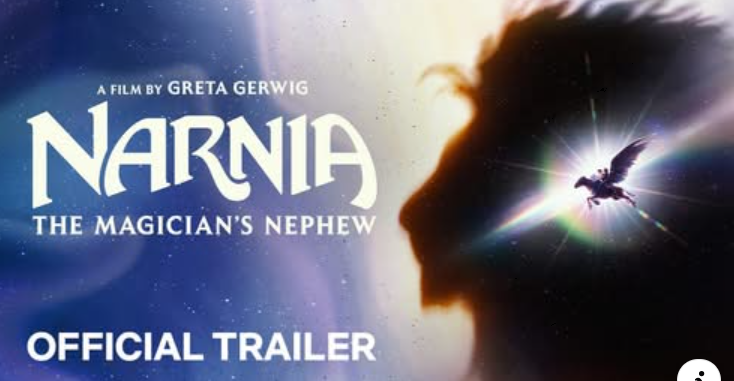
In February, my favourite Narnia book finally reaches the cinema. Greta Gerwig’s Narnia: The Magician’s Nephew will be the first ever screen version of the ‘creation story’ of Narnia, where Aslan sings a new world into being.
As a self-confessed Narnia nerd, I am excited. But many hardcore Narnia fans are not happy. To put it mildly.
The biggest trigger of anger was confirmation that Meryl Streep will voice Aslan. Within hours, the casting was being called ‘creative vandalism’, ‘woke’ and even ‘blasphemous’.
Some have even started calling Gerwig’s version of Aslan ‘Tashlan’, after the fake god dreamed up by the treacherous ape Shift in The Last Battle.
So this is my appeal to my fellow Narnia nerds: hold your nerve.
What actually matters
Six years ago, when Netflix bought the rights to Narnia, I wrote them an open letter with five things they needed to get right with this adaptation. These were:
- Understand the thinking behind the books
- Recreate the distinct atmosphere of each book
- Embrace Narnia’s spirituality
- Get the central character right (Aslan)
- Interpret it for a new audience
I still think these are the key things. And none of them can be judged from a cast list.
Reinterpreting for a new audience
We know that Gerwig has moved The Magician’s Nephew story from being set in the 1900s to the 1950s. The book’s Edwardian London context, with its hansom cabs and Sherlock Holmes still living in Baker Street, is part of its charm, and I will miss it.
But this is exactly what I meant by point five – we have to embrace some new twists of interpretation. Disney opened The Lion, the Witch and the Wardrobe with the children’s house being bombed in the Blitz, scenes which Lewis never described, and it made the film better.
As I wrote in 2020, if the core holds, ‘stylistic changes’ can enhance the story. All stories need reinterpreting for a new audience.
So for me, if Gerwig re-arranges the timing, I can cope. And if the knock-on impact means that The Lion, the Witch and the Wardrobe ends up being set in the 1990s then I think this could be a fascinating take on the story.
Getting Aslan right
The gender of the person voicing of Aslan is a far bigger issue, and I understand why.
Unquestionably, Aslan is the heart of Narnia, and for many he was an important way of coming to know Jesus better. This is sensitive ground.
In 2020 I wrote that getting Aslan right will be ‘a huge part of getting Narnia right’. He must be both immensely powerful and deeply attractive: wild, joyful and never tame. A nice, predictable or boring Aslan would be far worse than one who surprises and disarms us.
Imaginative stretch
But think about what C.S. Lewis actually did. He took a first-century Jewish carpenter/preacher and re-imagined him as a talking lion. With paws. And a mane.
He always insisted this was not merely allegory but a ‘supposal’: suppose the Son of God came to a world of talking beasts, what might he be like?
That is a huge imaginative stretch, and we have all happily made it. Is a lion with a woman’s voice really so much further?
After all, Jesus himself, when looking over Jerusalem, compared himself to a mother hen longing to gather her chicks under her wings.
And the ‘Tashlan’ jibe misses Lewis’ point. As I wrote earlier this year, Shift’s false Aslan is utterly greedy, manipulative and murderous. It was his terrible character that was evil, not the pitch of his voice.
What would ruin it
None of this means that I will be happy with any changes. There are plenty of ways that Greta Gerwig could make a real mess of Narnia.
And as I argued 6 years ago, Gerwig’s Narnia must embrace the earthy, integrated spirituality which infuses each of the books. If she airbrushes this out and replaces the biblically-inspired themes with New Age fluff then the films will fail.
Generous judgement
But I don’t see the early signs as bad as many do. Gerwig says she fell in love as a child with the idea of ‘a cosmic lion singing the world of Narnia to life’, and that she wanted a voice which could carry depth and pathos as well as joy and delight. That is a pretty good description of the Aslan I met in the books.
And lets not forget that C.S. Lewis’ original books already contain themes which make some conservative Christians nervous, such as Aslan’s generous judgement on those who have worshipped other gods in The Last Battle. Lewis would never have described himself as an Evangelical and his views cannot be co-opted by one section of the contemporary church. Like Aslan, Lewis cannot be tamed by either conservative or liberal ownership.
Let’s not be Uncle Andrew
Gerwig is a creative genius, and genius is not always comfortable. Her Little Women chopped up the timeline of a much-loved book. I thought it was brilliant, but it was not to everyone’s taste (my Mum didn’t like it). I am sure her Narnia may well divide us too.
But we should at least see it first. In The Magician’s Nephew, when Aslan begins his creation song, Uncle Andrew has already decided that a lion cannot sing. So he convinces himself that all he can hear is roaring and snarling. By the end he could not have heard the song even if he had wanted to.
Let’s not make the same mistake. The books are still on the shelf and no film can change a word of them. I am glad that someone as talented as Greta Gerwig is taking Narnia seriously.
So lets calm down, hold our nerve, and let’s see what it’s like in February.
I preached a sermon on The Magician’s Nephew a few years ago: read or listen here: Finding God in Narnia: The Magician’s Nephew
Other Narnia content on G+T:
- Recreating Narnia: an open letter to Netflix
- Re-discovering Narnia and rinsing out stale thinking about Christianity
- ‘The Lion’s World: A journey into the heart of Narnia’ by Rowan Williams [Review]
- The Donald Trump of Narnia: a Shift in The Last Battle?
Discover more from Grace + Truth
Subscribe to get the latest posts sent to your email.


This is a lovely reminder, Jon, to discern rather than judge. So easy these fast-moving-social-media-AI days to leap into condemning judgment based on minimal information. I’ve done it many times myself, and will, with little doubt, do it again. But here’s an invitation to do exactly NOT that. The pause for thought is probably one of the most valuable tools we have as humans. We too easily forget we have it.
What would Aslan do?
LikeLiked by 1 person
I am write with Tobias. “So let’s calm down, hold our nerve, and let’s see what it’s like ….” is, I think, pure gold. If, as Christians, we did this more often and discerned what it is that is really worth getting worked up about, we might make a significant contribution to the life of the human family. Thank you
LikeLiked by 1 person