A Conservative minster who clashed with Margaret Thatcher is reported to have said:
“The trouble with Margaret is that when she speaks without thinking, she says what she thinks.”
Seven words
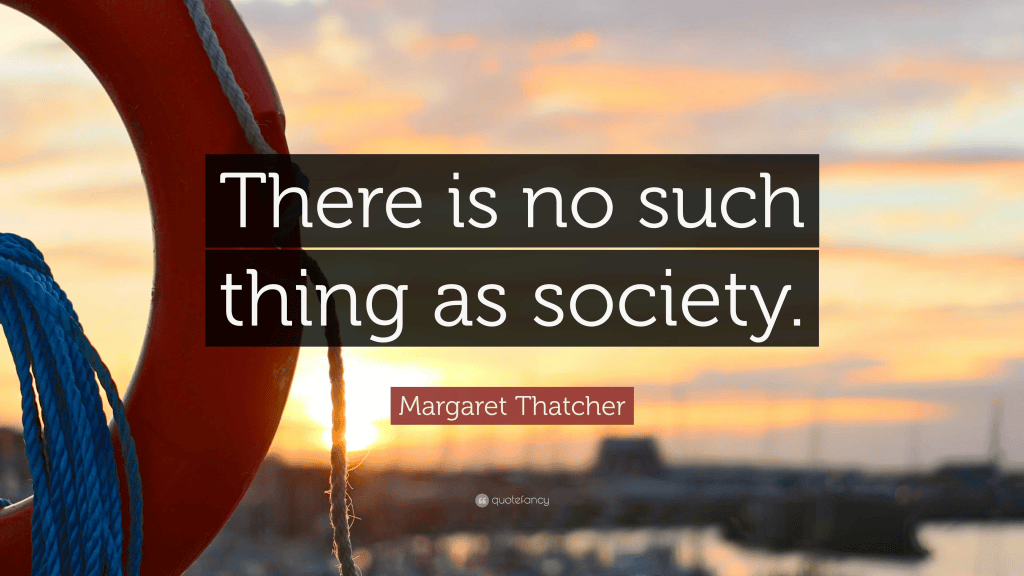
In an extensive interview for Woman’s Own magazine in September 1987 Thatcher said what she thought. In response to over 50 questions, her answers extended to almost 10,000 words. Seven specific words though have echoed down the years:
“there is no such thing as society”.
For critics of Thatcherism, these words continue to provide the most damning evidence of its malign influence. They encapsulate the worst excess of the 1980s ‘me first’ culture that I and my student friends professed to hate.
Nearly 40 years on though I am not so sure. In fact what she said seems to me to contain important truths in grave danger of being forgotten today.
What did she actually say?
The context of these famous seven words were:
“[too many] people are casting their problems on society and who is society? There is no such thing!
There are individual men and women and there are families and no government can do anything except through people, and people look to themselves first. It is our duty to look after ourselves and then also to help look after our neighbour, and life is a reciprocal business and people have got the entitlements too much in mind without the obligations …
There is no such thing as society. There is a living tapestry of men and women and people and the beauty of that tapestry and the quality of our lives will depend upon how much each of us is prepared to take responsibility for ourselves and each of us prepared to turn round and help by our own efforts those who are unfortunate.”
Taking responsibility for ourselves
The news today is awash with stories and opinions about what ‘they’ – ‘the state’ or ‘the government’ or ‘society’; whatever name you give to that amorphous force supposed to help and sustain us without any effort on our own part – should be doing for ‘us’.
It seems we have a seemingly never-ending narrative that “something has gone wrong, and someone else should do something” about it.
Turbocharged by the experience of the pandemic, when people were – quite rightly – protected by ‘they’ from a deadly virus and financially supported, there is now a growing sense that pervades Britain that people should be protected from losing out in any way. A belief that ‘they’ can, and should, fix everything for ‘us’, whether by rebate, exemption or recompense.
The risk is that the game of life played this way overwhelmingly descends into a ceaseless struggle to obtain dispensation, mitigation and support, from ‘they’, for everything.
And, in the course of that, people’s sense of agency, and notion that they themselves have some responsibility for facing, and overcoming, the challenges of life, can evaporate.
Taking responsibility
Welfare state protections are a hugely important safety net for those who need them. Britain is justly proud of the welfare system it has built over the last 80 years.
But there is a risk, and a balance to be struck. The risk is that the existence of the welfare state undermines, rather than supports, a caring culture of people taking responsibility for helping others.
Prior to the existence of the welfare state, people had to rely on each other – on family, social and community ties that they had invested in and built up – as it was the only safety net there was.
The ability of people today to rely on the welfare state is all well and good as far as it goes, but what if family, social and community ties wither as a consequence? If the state is expected to care for everyone, what does this do to people’s willingness to help other people, even those in their own family?
Mrs Thatcher at The Vine
What got me thinking about what Mrs Thatcher actually said is my experiences at The Vine, a community gathering held at Streatham Baptist Church on Wednesday nights. It’s a place where those struggling most in life can come in for faith, food, company, games and an always inventive quiz.
Even at The Vine though there is no such thing as a ‘free lunch’. Those attending must exercise agency and take some responsibility for themselves. They must get themselves there on time. The aim is to work against the dangerous creep of the passive receiving of resources and to seek human engagement. Everyone coming has to engage with others in some form, as far as they are able. And all are encouraged to help out, put tables and chairs away and serve together.
The volunteers who cook the food, chat, play games and deliver the messages of faith with those coming through the door, are not agents of ‘they’. There is no state funding, no contract delivered, no strategic plan. They are ‘us’, people with handwritten name badges who have taken the responsibility to come together on a dark weeknight to deliver connection and sustenance to others.
This is the ‘human tapestry’ that Margaret Thatcher spoke of. It is woven – by people, for people – and it happens in deepest Streatham every Wednesday night.
Let’s not contract out all of our sense of responsibility towards others. And let’s recognise the beauty of the tapestry we can weave together.
Jonathan Thomas is a Senior Fellow at the Social Market Foundation think tank.
Read about The Vine: Keeping social action salty and The contributory principle: everyone can do something for others
Discover more from Grace + Truth
Subscribe to get the latest posts sent to your email.

