
“You can do more with 12 disciples than with 1,200 religious consumers.” Alan Hirsch
I used to be in a church with someone who was never happy with how things were run. People tried hard to include her but nothing was ever good enough.
Once, in a discussion about how we could serve the local community better, she said:
“The thing about me is, that not only do I like to take, I also like to receive.”
She had meant to say ‘I also like to give‘ but actually her mis-spoken words were pretty accurate. She could not appreciate why everyone was laughing.
But lets face it, this is real danger among many churchgoers. It is easy to take and receive and it can be a real challenge to encourage people to step up and serve.
A curse of our age
Consumerism is one of the curses of our age. And the church is not immune to it.
People can easily go along to church for years and just be stuck in receive mode. They can judge the quality of the music, assess how engaging the sermon was, or how much their kids enjoyed the children’s groups.
And when their experience does not match their expectations, they can up and leave and go to another church. And in Christian circles, there are plenty of ways this can be dressed up as a spiritual decision: ‘We believe God is calling us elsewhere for the coming season.’ That kind of thing will generally get nods of spiritual affirmation.
And now of course, there is no shortage of Christian resources available to consume by yourself without leaving the house: the best sermons, the most brilliant worship music and the deepest contemplative prayer are all available on the internet. And you don’t even need to negotiate the annoying people at your church!
Except you do. Those ‘annoying people’ are more important to your soul than any of the most brilliant sermons you can listen to by yourself.
You need others
Following Jesus cannot be done in isolation: Christianity is not an individual spiritual self-help programme. And you do not grow just by consuming certain religious experiences.
The Christian faith is about following the Way of Jesus. Discipleship is about learning to do this in community.
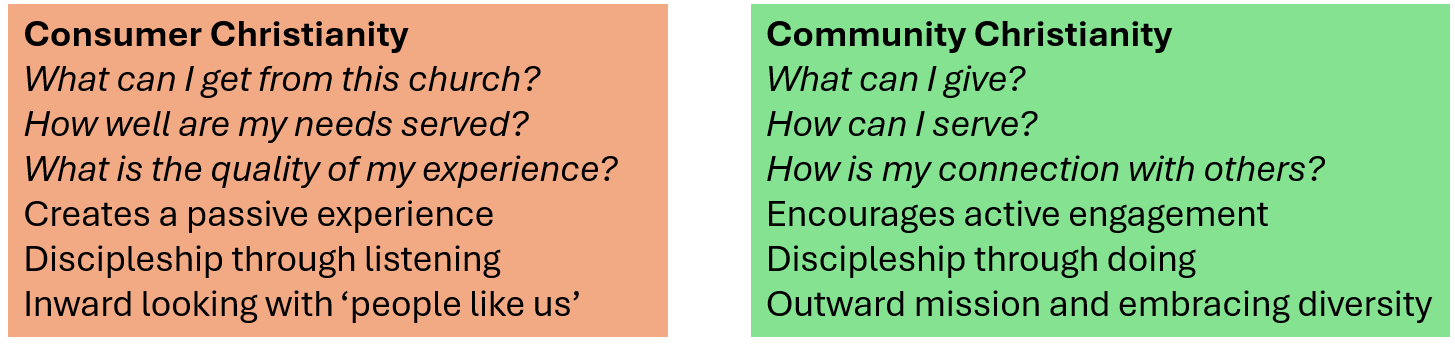
Jesus does not call us to be religious consumers but calls us to build authentic community. His Way calls us to give, serve and connect with others different to us rather than be a consumer of religion:
The organisation I work for, Hope into Action, works closely with churches to house and support people who have been homeless. We believe passionately in what the local church can do to offer friendship and community.
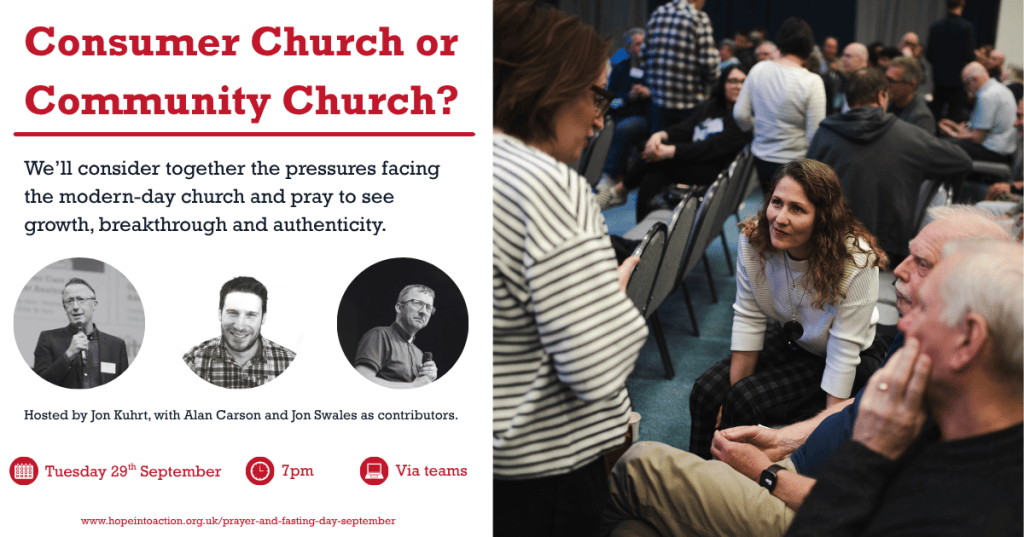
We are hosting a special evening on Tuesday 29th September which is open to anyone who wants to explore these themes. We have two brilliant speakers who are on the frontline of local church leadership with people on the margins – and both have previously contributed to G+T:
Jon Swales MBE, leader of the Lighthouse Community in Leeds and runs the Mission, Theology & Ministry for the Margins course. And Alan Carson, associate pastor of Belfast City Vineyard, CEO of Storehouse and Hope into Action Belfast.
We will consider together the pressures facing the modern-day church and pray together for the church across the UK to see growth, breakthrough and authenticity. Come be encouraged, inspired and invigorated to help your home church be less ‘passive observers’ and more ‘essential contributors’ to the outworking of our faith.
Please see here for all information: 29th September – Prayer and Fasting Day | Hope into Action UK
Discover more from Grace + Truth
Subscribe to get the latest posts sent to your email.


An insightful piece, Jon, thank you. I just wondered whether the contrasting approaches could be re-framed as between ‘Consumer Christianity’ and ‘Communion Christianity’? By ‘Communion’ I mean a corporate experience of Christianity that includes both seeking union with each other, through self-giving within the community, and seeking union together in Christ, through listening, praying and sharing in sacramental worship.
LikeLike
Thanks David for reading and commenting. You have made this point to me before and its worthy of deeper reflection. Thanks for pressing this point again. The danger with talking about ‘community’ is it can lead to busyness and activity which detaches from God. As I found in the research I did (which you read previously) on my former church community in my 20s was that the ‘community’ we experienced was directly linked to the ‘conviction’ that was shared. (for more see ‘Faith 20 Years On’ Introduction to the research – Grace + Truth)
And I think ‘communion’ – especially as its such a connected word to community – is good to think about as the point of distinctiveness, as the gathered people’s key moment of connection with Christ and the mysterious way that it helps us to participate in his life, death and resurrection.
I think what I find hard is when communion, or mass, is turned into a ‘consumer ritual’ which has no authentic ‘community’ alongside it. So often I see that there is little space for reality or authenticity to ‘breathe’ through what is being done. The peace, often shared in C of E churches, has such massive depth to it when it is done with depth and reality but so often its a perfunctory handshake.
Last week at the Hope into Action retreat, we had communion to end the 2 days but we did it differently with a table with 12 chairs and to take communion you went and sat at the table. As we had 70 odd people there the table kept changing with new characters coming and going but all sharing in One Table. I found it profoundly moving – as we commit to each other and to serving people who are homeless – but with Christ’s death and resurrection as the foundation. I think its an image which speaks to your point.
As I have said, if you wanted to write something for G+T on this point then I would love to publish it. I am sure you have much wisdom to share after a lifetime of ministry and through serving and enabling communion! Thanks and God bless.
LikeLike
Thank you, Jon, for taking the trouble to reply to my brief contribution about the term ‘communion’. What I like about this word is that it suggests, to me, a gentler, less busy, less activist, more Christ-centred kind of church than ‘community church’. There is, for sure, a place for churches to be involved in community welcome, outreach and service, but the heart of ‘church’ is, I believe, the gathering of believers and not-yet believers, out of the separateness and strains of life, to worship God. They do so, not as spectators or consumers of a presentation at the front, but as participants who are drawn closer together – through reflective listening to the Word, harmonious singing in praise, antiphonal offering of prayer, and symbolising their union through sharing bread and wine in the Sacrament. The way this was enacted – 12 chairs round one table – at the Hope into Action Retreat is a moving example of comm-union being expressed, not through any consumerist attitude, but through simply sitting alongside one another, being re-connected to the source of life and love, and being inspired to go back into the world to love our neighbours.
I like this (not related) quote from Rowan Williams: “Being human is to live, not as consumers of the world, but in communion with it.”
LikeLike
I have said this before but I also believe that some churches have built a rod for their own backs in part due to the professionalization of leadership. This produces a them-and-us culture that only feeds the consumeristic tendencies. When a church leader understands a lot of their task is to “equip the saints for ministry” and that *my* gifts brought to the community are no less than *your* gifts – it changes things. When I brought the idea of starting Alpha to our church leaders in California, and the Pastor said “great – go do it”, it was very empowering and we got straight to work. I am learning how unusual that was…
LikeLike