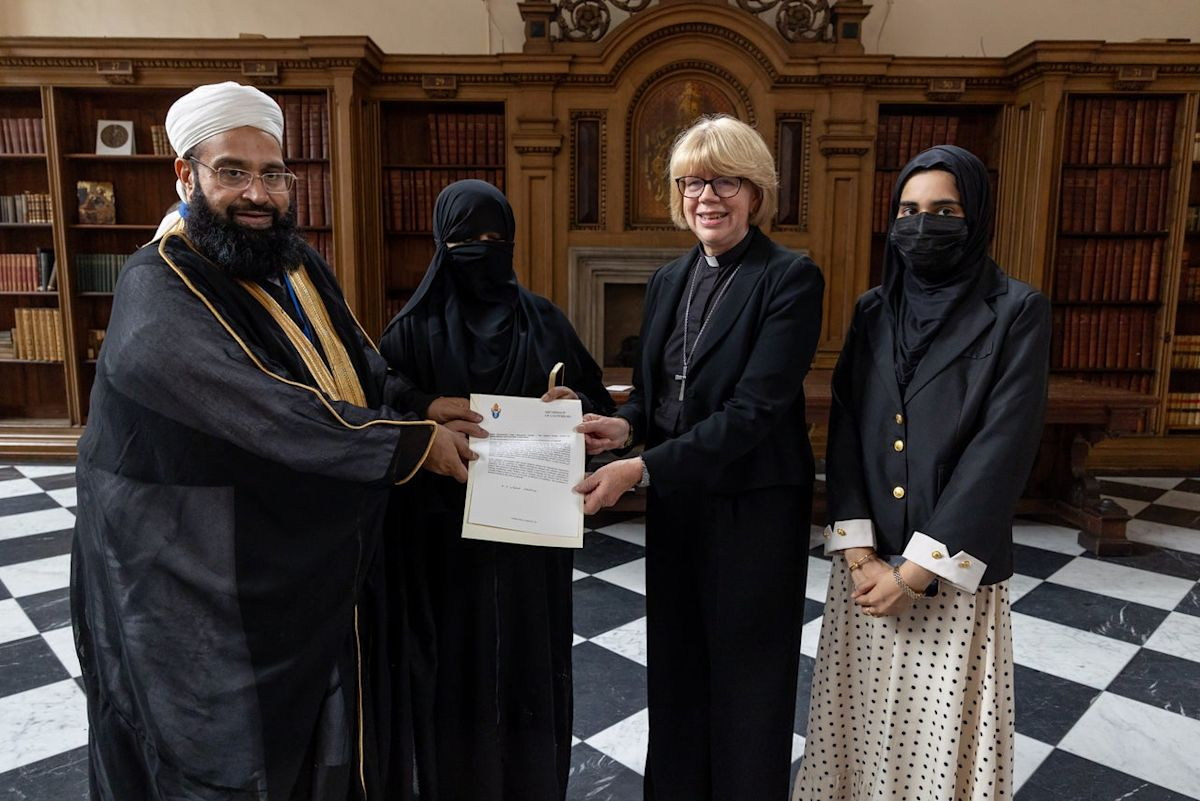
The image of the Archbishop of Canterbury, Sarah Mullally, presenting the Pakistani cleric Hafiz Muhammad Tahir Mehmood Ashrafi, with an award for ‘Reconciliation and Interfaith Cooperation’ managed to unite both the National Secular Society and a great many British Christians in bewilderment.
The picture itself showed a stark contrast between attitudes to women in Islam and Christianity. A woman has been appointed as the leading cleric in the Church of England, whereas the Muslim award winner’s wife was shrouded in a niqab with only the narrowest slits for her eyes.
Other elements were deeply problematic too. Reports emerged that Ashrafi had conferred on Osama bin Laden the honour of Saifullah, “Sword of God”, in protest at Salman Rushdie being awarded a knighthood. And the date the Archbishop presented this award to Ashrafi could not have been more unfortunate – the 25th anniversary of the 9/11 terrorist attacks that bin Laden masterminded.
Six days later Lambeth Palace withdrew the award.
Lost details
This is more than a PR gaff and the failure of due diligence is serious. The key questions are: Who is the specific person or group was who took the decision to make the award? What was their process? And what should be done differently going forward?
Addressing this institutional failure within Lambeth Palace is more important than simply criticising someone six months into the hardest job in the Church of England. After all, the nomination for this award did not originate with Sarah Mullally and was made before she took office.
The case for acknowledging Ashrafi’s work
The lawyer in me likes to look for a defence for an individual or institution in the firing line, and there it is stronger grounds for acknowledging Ashrafi’s work than many of the British headlines allow.
I spent a year in Pakistan working for a missionary society, and I have kept an interest in the country and in what Christians there pay for their faith.
It is worth saying that Pakistan’s Anglican leadership approved the award to Ashrafi. Dr Azad Marshall, Bishop of Raiwind and Moderator of the Church of Pakistan, has said publicly that he personally recommended Ashrafi during Justin Welby’s visit to Pakistan. He was dismayed by its withdrawal, and on the day Lambeth Palace rescinded its award, he presented Ashrafi with a “Global Peace Award” of his own.
Brave intervention
The reason for this honour lies in Ashrafi’s intervention in cases like Rimsha Masih’s. In August 2012, Rimsha, a fourteen-year-old Christian girl with Down’s syndrome, was arrested in a slum on the edge of Islamabad after a local imam accused her of burning pages of the Qur’an. A mob gathered at the police station demanding punishment, and hundreds of Christian families fled the neighbourhood overnight.
Generally in Pakistan, powerful men do not intervene in blasphemy cases because of fear of assassination. Politicians have been murdered for suggesting the laws be reformed.
However, Ashrafi did choose to intervene. As chairman of the Pakistan Ulema Council he held a press conference alongside senior clerics and Christian community leaders, publicly called Rimsha a “daughter of the nation” and condemned attempts to incite hostility against the Christian minority.
Demanded investigation
That same weekend, witnesses from the local mosque came forward to say the imam had planted torn pages of the Qur’an in the bag of ashes Rimsha was carrying, in order to secure a conviction and drive Christians out of the area. Ashrafi said publicly that Muslim heads were bowed in shame at what the imam had done. He demanded a full state investigation and undertook that if the government failed to protect the family, the Ulema Council would guarantee their safety itself.
All charges against her were quashed by the Islamabad High Court that November, and she and her family were quietly relocated to safety in Canada. When the imam was acquitted of framing the girl in 2013, after witnesses retracted their statements under alleged pressure, Ashrafi called it a disappointment for everyone working for religious harmony.
None of this makes him a liberal. Ashrafi supports the blasphemy laws in principle, arguing only that they are being turned into a “mockery” by false accusation and need police reform to stop them serving private vendettas. Human rights groups disagree and state that a law which produces mob violence cannot be redeemed by occasional interventions on behalf of the few who catch a powerful man’s attention.
Complexity
This is the complexity that the angrier media coverage has no room for. The position of Christians in Muslim-majority countries is precarious and complicated. Opinion among Pakistani Christians is divided: the mainstream denominations welcomed the award, smaller minority churches did not.
Sometimes the man who looks to us like a hard-line fundamentalist is actually the one standing between a Christian family and a mob. We have to appreciate persecuted Christian’s gratitude to Ashrafi.
Individual Muslims, including conservative ones like Ashrafi, may be kind, hospitable and brave — braver than many of us who call ourselves Christians. His work for Pakistani Christians deserved recognition.
Theological confidence
But we need to maintain a theological confidence in the distinctiveness of Christianity. We have to be honest about the significant differences that exist between the beliefs of Islam and Christianity and the ethics that flow from them. Acknowledging difference is essential to truly respectful relationships.
A warm, public letter of thanks to Ashrafi for his specific work in highlighting the way the blasphemy laws in Pakistan are being misused would have honoured him properly, cost nothing, and spared everyone from this fiasco, not least Ashrafi himself, and the Pakistani minority groups now living with the fallout.
But a publicly photographed, interfaith ceremony was a disaster and exposed the naivety and lack of wisdom and discernment at the heart of the Church of England.
Rev. Martin Kuhrt is Vicar of the Church of the Holy Spirit in Aylesbury
Discover more from Grace + Truth
Subscribe to get the latest posts sent to your email.


Thank you Martin for this careful piece which sets out well the much more complex background than the media are prepared to investigate. I was ++Rowan’s Inter Religious Affairs adviser at the time of the Sharia law outcry, based on a shoddy distortion of something he said in an interview following a major lecture at the Inns of Court. I also made a number of visits to the Church of Pakistan
I agree with your conclusions that something like a letter of thanks or perhaps the Church of Pakistan’s Award (incidently the Roman Catholic Church in Pakistan has also given one to Moulana Ashrafi) to be given in Pakistan with a ABC representative present. As to the photo, it is really hard to understand why Comms advisers ever permitted it – such naivety. All this has given real comfort to the more extreme ‘Christian nationalist’ groups
LikeLike
Thanks Guy, I agree.
LikeLike