
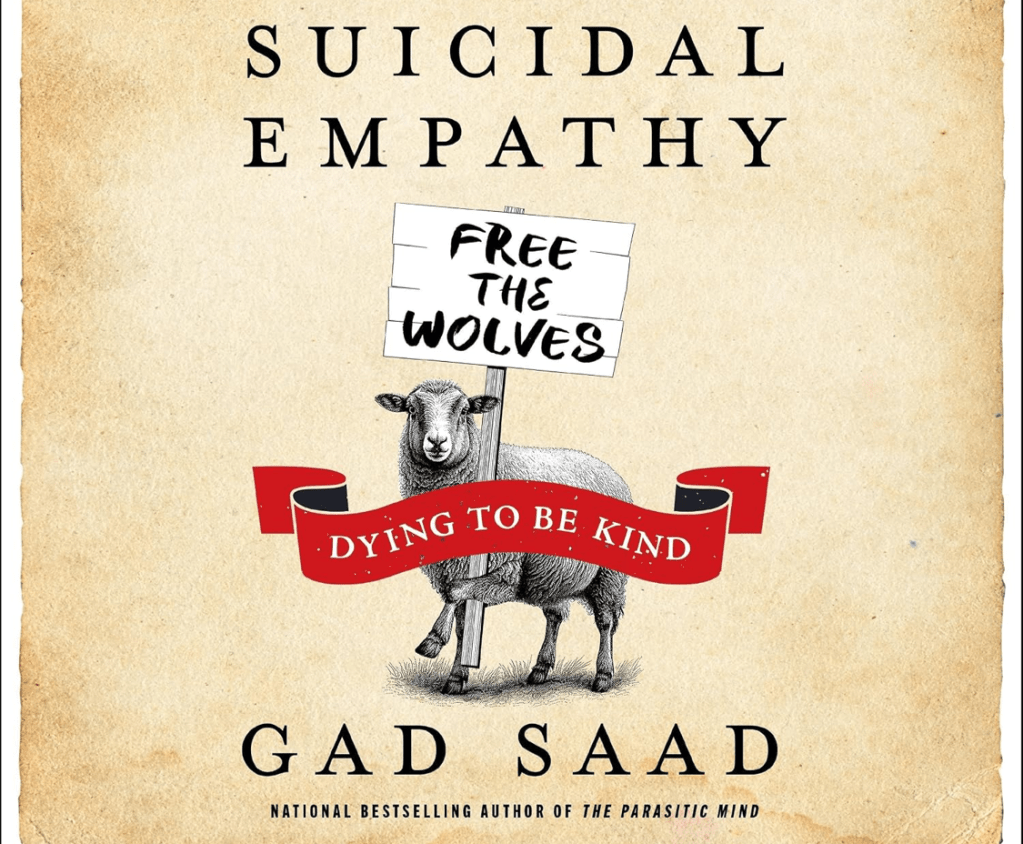
Review: Suicidal Empathy: Dying to be Kind by Gad Saad (HarperCollins, 2026)
I am drawn to books which explore the complexities in how we help others: Toxic Charity, When Helping Hurts, The Kindness that Kills, Beware of Pity.
So after just hearing the title, I ordered Suicidal Empathy without knowing much about it.
The first thing I noticed when it arrived was the commendation on the front cover, from the world’s richest man, Elon Musk. It tells you a lot about the book’s political sympathies and its target audience.
Gad Saad is a professor of behavioural science from Canada. He was born into a Jewish family in Lebanon and fled the civil war as a child. That matters – when he warns about the dangers of naivety in the face of people who genuinely wish you harm, he is not speaking academically.
He opens with his definition:
“Suicidal empathy is a tragic manifestation at the civilisation level, of the well-known proverb ‘The road to hell is paved with good intentions’.”
I have quoted that proverb a great deal myself, across twenty years of articles, workshops and discussions on the dilemmas of helping people affected by homelessness. So we begin on some common ground.
But Saad’s focus is not the front line. It is the social and cultural damage he believes progressive liberalism has done to the West’s ability to defend itself:
“I posit that in the current zeitgeist, the collective suicide of the West is occurring via the orgiastic misfiring of one of our most noble virtues, empathy, which of course is deeply anchored within the ethos of progressive liberalism.” (p9)
What he gets right
Saad’s thesis contains vital challenges which we need to engage with.
He is right that progressive thinking tends to locate evil structurally rather than personally. He describes the preference to “attribute all failures to external forces rooted in the evils of the West” and “to create narratives of empathy and care rooted in a never-ending recursive web of intersectional victimhood.”
I have experienced environments which embody this weakness: endless talk of systems change and strenuous avoidance of personal responsibility. Making every problem society’s fault, and stripping people of their agency in the process, is itself a well-paved road to hell.
He is right, too, that a sentimental view of human nature can be lethal. He recounts the tragic story of Jay Austin and Lauren Geoghegan, who set out to cycle around the world to demonstrate global human kindness. They wrote: “Evil is a make-believe concept we’ve invented to deal with the complexities of fellow humans holding values and beliefs and perspectives different to our own.” In Tajikistan, as they travelled, they were seized and murdered by ISIS. As Saad comments:
“The world does not abide to one’s erroneous view of human nature… reality does not abide by your feelings…be empathic to the truth.”
Empathy traps
I see aspects of these ’empathy traps’ constantly.
Charities built entirely on one-way giving, generously and freely distributing resources with little thought for what actually helps people change.
People with addictions being enabled to receive large back-payments of welfare benefits, PIP especially, despite the windfall being obviously destructive to their wellbeing.
Christian charities so anxious to be inclusive and empathetic to difference that they quietly extinguish the faith which founded them.
So I am not reviewing this book as someone who thinks empathy is above criticism. Our empathic instincts need managing with boundaries and honesty. Grace requires truth.
A one-eyed argument
Saad frequently refers to homelessness and uses American cities, San Francisco especially, as proof that empathetic policy destroys public space by allowing encampments of tents. According to Saad, structural explanations for homelessness are not incomplete; they are incorrect:
“Progressive policies ignore the fact that homelessness is in large part due to mental disease and substance addiction…it is more empathetic, albeit incorrect, to blame greedy capitalist landlords for the lack of affordable housing.”
But homelessness is caused by both structural and economic injustice as well as personal tragedy. Unaffordable housing and broken systems create huge cracks in which those who have experienced trauma, mental illness and addiction easily fall into. Both realities help explain the homelessness you see on the street.
This is why Andy Burnham’s pledge to end rough sleeping, made on his first day as UK Prime Minister, needs a clear philosophy behind it as well as money. How will the system respond to those who sleep rough after trashing their accommodation or threatening the staff employed to help them?
Ending rough sleeping means grappling with these tough questions. Solving complex social problems requires more than optimistic empathy.
Differences with Against Empathy
Paul Bloom’s 2016 book Against Empathy: the case for rational compassion critiques emotional empathy as an unreliable guide and argues for proportionality, boundaries and intelligent giving. I appreciated it because his purpose was to help people help others better.
In contrast. Saad’s purpose is political, and his alternative is not better help but more punishment, more suspicion, more self-protection.
The difference shows in the central metaphor. Saad’s is infection: a “mind parasite” that has hijacked the “empathy module” of progressive elites. It is a vivid image, but it argues that opponents are not just wrong, but diseased. They do not need answering, they need curing.
Sarcasm and contempt
Saad may be a scientist, but this is a nakedly political book, and his arguments are supplemented by a stream of sarcasm and contempt. He delights in sharing his social media exchanges, such as when he described someone as a “human pig”, Democrat politician Kamala Harris is described as “a lobotomised cackler” and Islam is continually presented in its only very worst forms. Rather than disagree in good faith, Saad continually dismisses and belittles.
Saad says he wants the West to wake up before it is too late. But scorn wakes nobody. It recruits those who already agree, hardens everyone else, and makes the accurate parts of the book unusable by the very people who most need to hear them. Whatever is true here is neutralised by the way it is said.
There is truth in this book, but little grace. And this simply increases the bitterness of the culture wars and the resentments which ricochet between liberals and conservatives.
Love your enemy
The deepest theological question in the book is raised almost in passing:
“Perhaps the injunction from the New Testament to love your enemy is at the root of earthly suicidal empathy.” (p60)
It is no surprise that Saad baulks at Jesus’ command to love those who hate us. His framework is evolutionary: love is measured by whether it aids survival, so sacrificial love is by definition a problem. On his terms, the crucifixion must be the worst act of suicidal empathy in history.
And this is the nub of the tension. Christian faith is built upon an understanding of a God who accepts death rather than inflicts it. The cross displays the depth of divine, redemptive love, as Jesus even forgives those who are killing him. ‘Taking up our own crosses’ is the route to transformation – and this is very different to self-preservation.
But loving your enemy is not pretending you have none. Jesus was not naive about human nature. He told his followers they must be born again, that they need to be as shrewd as snakes as well as innocent as doves. His life, death and resurrection were the embodiment of both grace and truth – and this is why his life continues to fascinate a world desperate for both.
The way of Jesus’ is neither the sentimentality Saad attacks, nor the contempt he offers instead.
Verdict
Suicidal Empathy names something real. Compassion detached from truth does cause harm, and naive good intentions do pave roads to bad places.
But a book about the failures of kindness ought to understand what kindness is for. Saad has written to win, not to persuade, and the result will bolster one side of the culture war rather than build the wiser, tougher compassion the world actually needs.
There is a serious book to be written on this subject. Saad-ly, this is not it.
Buy Suicidal Empathy: Dying to be Kind by Gad Saad
Also see: When helping the homeless doesn’t help
Discover more from Grace + Truth
Subscribe to get the latest posts sent to your email.


Thank you for reading this, so I don’t have to!
LikeLike