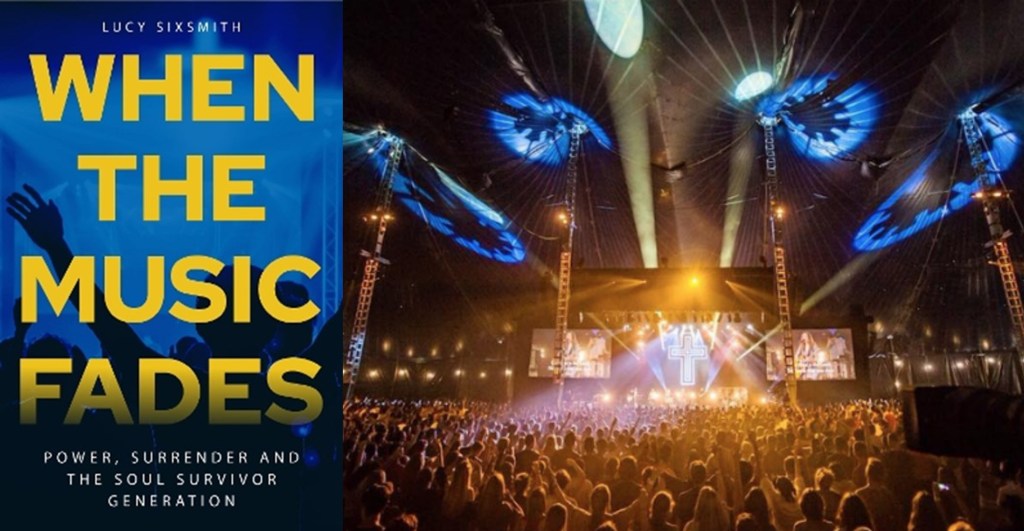
Soul Survivor was a popular and influential Christian youth festival which ran from 1993 to 2019 and attracted thousands of young people every summer. In addition, there is also a year-round church based in Watford with the same name.
Both had been founded and led by the charismatic youth worker Mike Pilavachi.
As a teenager, Lucy Sixsmith attended the festivals and describes how the event defined her faith and self-perception:
“Soul Survivor was the whole country’s evangelical youth group. Sitting amongst thousands…we felt both the excitement of scale and the safety of belonging: here, it seemed, were thousands of our own tribe, people who loved Jesus in the way we did.”
But what happens to this sense of ‘excitement and safety’ when a different sort of reality emerges?
Wider culture
In 2023, investigations exposed significant safeguarding concerns about Pilavachi’s behaviour. A full independent review led by Fiona Scolding QC later confirmed how he repeatedly developed inappropriate relationships with young men over 40 years of ministry – manipulating, controlling, as well as wrestling and privately massaging them.
Yet Sixsmith is clear about her focus: “This book is not really about Mike Pilavachi…it is about the wider culture of charismatic evangelicalism in Britain in the nineties and noughties.”
It is one person’s attempt to make sense of what she was part of – sorting through “what was helpful and what was harmful, how we messed up or were messed up, and whether and how that sub-culture enabled abuse, or was itself abusive.”
What remains?
When The Music Fades is a great title for the book. Using the lyrics of one of the most well-known worship songs which emerged from the Soul Survivor era, it asks the fundamental question: what remains of worth when excitement dissipates and reality emerges?
I have been involved in Christian summer camps almost all my life, and for the last 18 years have helped lead a Youth Camp. I believe strongly in the good they can do. But I am equally aware of the dangers that need to be avoided and risks that need to managed relating to high emotions, vulnerable teenagers, manipulation, and the spiritual high followed by the inevitable comedown. Youth camps and festivals need evaluation that avoids both naive endorsement and unfair cynicism.
Vivid
Sixsmith largely manages this. She is a talented writer, vividly evoking the charismatic-evangelical world she whole-heartedly participated in. In some ways, her journey follows a familiar pattern of theological deconstruction that so many have been on, but her reflections are all the better because she generally avoids bitterness.
“I can take or leave WWJD bracelets and Text-a-Toasties and on the whole I would rather leave them. But I do miss that sense of the presence of God, the weightiness of the Spirit falling.”
She also captures nuances that an outsider might misunderstand when they hear the word ‘evangelical’. Pilavachi was far from being some slick, polished figure but self-deprecating and open about his loneliness and insecurities. The messaging was not judgemental but firmly focused on the Father love of God. And this was not an otherworldly, heavenly-focussed message, but one with a concern for the here and now: for justice, fair trade and community action.
Wildfire commitment
I found her reflections on Soul in the City, when thousands of Soul Survivor teenagers descended on London in 2004 to serve local communities, particularly interesting as I was part of the team who evaluated the initiative. There was no shortage of enthusiasm but with heavy irony, Sixsmith questions what was actually achieved:
“Two weeks of wildfire commitment of several thousand teenagers was meant to change something, and if we didn’t know what exactly, that was because of how high and deep and wide the love of God was, how unsearchable his plans were. It wasn’t about human goals, but God’s heart for London.”
She concludes that for her, Soul in the City was much more like a middle class holiday than an authentic taste of urban mission.
History-makers
Another key theme of the book is the legacy created by her generation repeatedly being told they would be ‘History Makers’, in the words of the popular Delirious? song:
“We were told that now was the time, this was the generation, when we had no sense of the shape of a life might be, or how complicated the world is, or how hard its problems are to solve. And now we are 30-somethings and 40-somethings, each with our own little chronicle of mundane successes and failures, each of us pressing on, more or less, and more or less bruised.”
Over-charged
Sixsmith’s critique of evangelical culture reminded me of the little-used word cant – which William Hazlitt defined as “the voluntary overcharging or prolongation of real sentiment.”
More subtle than hypocrisy, it captures the evangelical tendency to overstate and exaggerate and, in this case, intoxicate young people with a vision that didn’t match reality. A culture that proclaimed a generation would change history could not, as it turned out, manage its main leader’s behaviour.
Complex
I found the book fascinating but not without weaknesses. A fair degree of knowledge is assumed and it would have been good if some jargon was explained a little more for those outside this sub-culture. For example I know that WWJD stands for What Would Jesus Do?, but I had no idea what ‘Text-A-Toastie’ is.
Also, this is not a straightforward book and at points is a little too self-consciously ‘clever’ especially when it discusses the complex fusion of theology, history and teenage culture in the chapters on Surrender and Power. At some points, especially in chapters like Cake and Strong Boots, I must confess to struggling to follow what she was trying to say.
Struggle to process
I found the final chapter evocative and moving as Sixsmith returns to the London Borough of Bexley, where she had served during Soul in the City 20 years earlier, and attends a service at the Church of England congregation that had hosted her group. It is her first time in church in six months (‘there are lots of reasons for this and Soul Survivor is one of them’) and she wrestles internally with whether to take communion.
Her reflections on repentance and hope make for a quietly powerful ending. She captures the struggle I see in many to process their spiritual disappointment and what this means for their faith and the future. When The Music Fades reflects a sense of incompleteness and ambivalence that many will recognise.
Buy When the Music Fades: Power, Surrender and the Soul Survivor Generation – by Lucy Sixsmith (Canterbury Press, 2026)
Related:
Discover more from Grace + Truth
Subscribe to get the latest posts sent to your email.

 Grace + Truth
Thank for highlighting this jon, I might take a read as I went along to Soul Survivor events as a young adult rather than a teenager and was there to look after teens. I found the evangelistic events i took part in – Message 2000 and Soul in the City incredibly formative and useful but also really scary – i can remember being in West Norwood where I was supposed to be `doorman` for one hour and then going inside for an hour or so after. However, there was so much going on outside with local gang trying to break in and cause issues and was keying local cars etc that they left me out the whole time and it really felt like I was on the edge of good and evil. Inside the Holy Spirit was doing wonderful things with local gang leaders handing over drugs and weapons and coming to Christ but i didnt really experience that as i was trying to keep the peace outside and i felt quite let down as no one was coming out to check what was happening! It also led me to going to Durban and serving with Soul Survivor in the townships which deeply affected me also.
At the festivals i used to really enjoy being in God’s presence and also the self deprecation that was present with all the leaders being honest about their struggles and found that easy to relate to. It was also the site of one of my scariest Spiritual encounters when after the worship session one evening, one of the teenagers went into a `spiritual pregnancy` where she was manifesting childbirth. I had never experienced this before and it went on for about 16 hours which was exhausting, Jeannie Morgan was great though and explained what to do as a lot of other people didn’t seem to know what to do and being responsible for this teen going through this, it was a worrying time.
LikeLike
Wow Del – this kind of sharing of experiences is so important – both for the good and the bad. The experience in West Norwood is fascinating and I think would be echoed elsewhere that Soul in the City did generate very meaningful encounters and also formative experiences. When we did the evaluation, I think one conclusion was that where churches were embedded well in local communities that the SITC input could add meaningfully to this – but when it was just parachuting in the impact was far less – and ‘faded’ quickly. I remember spending the two weeks in East London and seeing loads of brilliant community work in places like Dagenham.
But the ‘spiritual childbirth’ story is something I have never heard of and frankly it terrifies me. Its this kind of story which just seems bonkers to anyone outside the bubble of such a culture. Where do you go with safeguarding with a story like that?
If you wanted to write any kind of further reflection on your experiences of Soul Survivor then I would be interested to publish it – especially how it has influenced all the homelessness and community work (I remember coming to hear you speak at the founding meeting of Love Streatham!) then I would be interested. Perhaps it could be titled ‘The Good, the Bad and the Ugly’?!
LikeLike
Reading When The Music Fades, also reminded me of the song, VBS, by American singer Lucy Dacus who muses on her experiences as a teenager on the ‘Vacation Bible School’:
In the summer of ’07, I was sure I’d go to Heaven
But I was hedging my bets at VBS
A preacher in a T-shirt told me I could be a leader
Taught me how to build a fire and to spread The Word
In the evening, everybody went to worship and weep
Hands above our heads, reaching for God
The song reflections on the teenage longing for God contrasted with complex realities in a similar way to Lucy Sixsmith. The song ends with this poignant line:
You say that I showed you the light
But all it did in the end
Was make the dark feel darker than before
LikeLike