Something feels fractured in the UK right now. There is a new hardness in the air. You can feel it on the streets, hear it in conversations, see it in our politics. For immigrants, refugees, Muslims, and people of colour, it can feel like the ground is shifting beneath their feet. Phrases like “send them back” and “stop the boats” are not just political slogans—they carry fear. They tell people they are unwanted.
Let me be clear: racism has no place here. Hatred wrapped in patriotism is still hatred. White nationalism is not a phantom invented by the media; it is real, and when race becomes the basis for belonging, exclusion, and fear, it must be resisted. When people are reduced to problems, when race becomes a weapon of exclusion, something deeply poisonous is taking root.
Progressive extremism
But extremism is not only found on one side. There is also an authoritarian instinct on parts of the activist left—a politics less interested in persuasion than in moral purity, where disagreement is treated as contamination. Some forms of progressive politics can become coercive, where dissent is shamed rather than debated, and complexity is flattened into slogans.
Neither tribe offers healing. And here is the real danger.
Those who came out to support UKIP, holding crosses and banners, may leave convinced not that they were challenged, but that they were persecuted. If every person there is simply labelled a Nazi, if they are treated as beyond redemption, mocked rather than engaged, dehumanised rather than challenged, it does not produce repentance. It produces hardening.
People who feel cancelled rarely become softer. They become angrier. More suspicious. More convinced they are the only ones telling the truth. Rejection becomes fuel. Shame becomes radicalisation.
Creating moral monsters
This is not to excuse genuine racism or extremism. It is to recognise how polarisation works. If we turn every anxious, frustrated, working-class person into a moral monster, we should not be surprised when resentment deepens and movements grow stronger.
And much of that anxiety is not born in ideology first, but in lived hardship.
The cost of living crisis has hit poorer communities hardest. Rising rent, food prices, heating bills, insecure work, closed services, stretched GP surgeries, disappearing opportunities—many people feel like they are drowning while being told everything is fine. They feel forgotten by Westminster, patronised by the middle classes, and spoken about rather than listened to.
They feel they have no voice.
Struggling communities
So when they see government money spent on hotels for asylum seekers while their own children wait for housing, when they see struggling high streets and communities already under pressure, it lands not as policy but as insult. Hotels are what posh people use for holidays; for others, they symbolise a system that somehow has resources for everyone except them.
Some of this perception is unfair. Some of it is manipulated by politicians and media. But much of it is rooted in real pain. If people believe nobody hears them, they will eventually shout.
And if nobody listens, they will follow whoever does.
Moral excommunication
For some, fears around immigration are also tangled with anxieties about cultural change, religious identity, and what they perceive as the growing influence of Islam in public life. Some speak—often clumsily and sometimes unfairly—about fears of cultural displacement, changing neighbourhoods, and social cohesion. These fears should not be dismissed with sneering contempt. They need engagement, challenge, honesty, and sometimes correction—but not instant moral excommunication.
If we want honesty, we also have to tell the truth about why trust has collapsed.
The scandal of grooming gangs hangs heavily over this country. For many ordinary people, it is not simply a news story but a wound—a sense that vulnerable girls were failed for decades, and that institutions looked away.
There remains a deep public perception—and in some cases documented institutional failure—that fear of accusations of racism contributed to silence, hesitation, and failures to protect vulnerable girls. That is devastating. When the vulnerable are not protected because institutions are afraid of political consequences, something has gone terribly wrong.
To name that is not racism. It is a demand for justice.
Truth not scapegoating
But neither should those crimes be used to condemn entire communities, particularly Muslims or Pakistani communities as a whole. Collective blame is lazy and dangerous. Justice requires truth, not scapegoating.
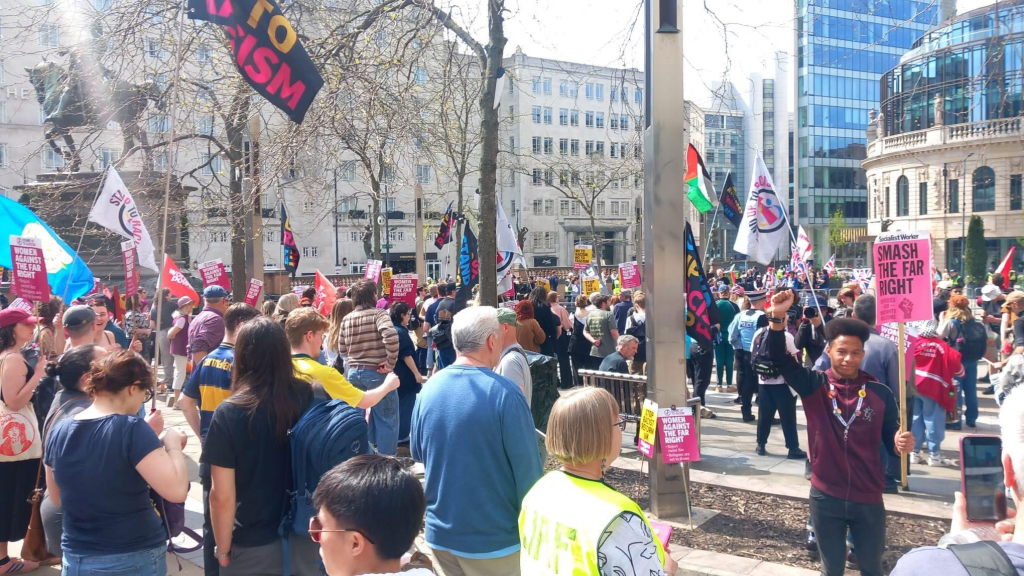
This weekend in Leeds, I saw some of this fracture up close.
There were around fifty people supporting UKIP, some holding crosses, some holding banners saying “Stop the Boats.” Opposite them were perhaps one hundred and fifty counter-protesters shouting, screaming, calling them Nazis. The loudest among them were carrying communist flags—the hammer and sickle held high.
Another authoritarianism
Now, anyone who has followed my writing knows I am no defender of unrestrained capitalism. I have written enough about greed, exploitation, and the way money can become a god that devours the poor.
But communism? The hammer and sickle does not make me think of liberation. It makes me think of Stalin, gulags, forced labour camps, thought police, and crushed dissent. It is strange to watch people denounce authoritarianism while waving symbols of another kind of authoritarianism.
Some shouted at the police too—officers simply trying to keep the peace and protect the democratic right to protest. They were mocked, told to get a proper job, treated as though standing between two angry crowds made them the enemy.
Maybe I need to be careful. I’m sure not everyone there was aggressive. Many were likely there because they genuinely oppose racism and fear what they see rising. But what I witnessed, at least in part, felt more like rage than peace.
Another gathering
And then, not far away, there was another gathering—people choosing welcome, hospitality, inclusion. They were calmer. Less interested in shouting, more interested in witness. I did not hear abuse there. Just presence.
That stayed with me.
Because the Church should be different.
Jesus called disciples from very different worlds. Simon the Zealot, shaped by revolutionary fire. Matthew the tax collector, seen by many as a collaborator with empire. Fishermen, doubters, the impulsive, the broken. He did not build a movement of ideological clones. He gathered unlikely people around himself.
The centre was not agreement on every political question. The centre was Jesus. That matters now.
The same table
The Church must be a place where people who disagree on immigration policy, economics, borders, and national identity can still kneel at the same table. Not because truth does not matter, but because Christ is bigger than our tribes.
We do not need churches baptised into left-wing purity culture or right-wing nationalism. There is also a temptation to confuse Christianity with national identity—to turn faith into a defence of tribe, border, and nostalgia, rather than the cruciform way of Jesus.
We need Christ.
Serious conversations
Can we defend the dignity of refugees and migrants while also allowing serious conversation about borders, responsibility, and what makes communities flourish? Can we oppose racism without turning everyone we disagree with into a monster?
Can we recognise that some fears are rooted in prejudice, and others in economic abandonment, institutional failure, social fragmentation, and political distrust?
Because inclusion also has to be tested. If inclusion only includes people who think exactly like us, it is not inclusion at all. It is just another tribe.
Something better
We are becoming a people who shout before we listen. Politics has become performance. Outrage has become its own religion. We need something better.
Conviction without contempt.
Justice without self-righteousness.
Welcome without naivety.
Borders without hatred.
Compassion without condescension.
And a Church brave enough to keep Jesus at the centre, while the world tears itself apart around the edges.
Rev’d Jon Swales is an ordained C of E Priest who heads up Lighthouse, a fresh expression of church for adults battered and bruised by the storms of life. See his Cruciform Justice website and the Mission, Theology and Ministry on the Margins course he leads.
Jon will also be leading a seminar at the Hope into Action conference on 20 May 2026 Rooted: Homelessness Ends in Community
Related: Reclaiming social justice from toxic identity politics – Grace + Truth
Discover more from Grace + Truth
Subscribe to get the latest posts sent to your email.


Wow. Thank you so much for this Jon.
LikeLike
Very interesting. I am a recent convert to Christianity as a result of a long, personal struggle to do with feelings, evidence, and stuff which is very hard to describe here but is to do with the Miracle of the Cross, my undertstandings of the key messages of Christ about unconditional love, forgiveness and the imperfect nature of us all. I am also from a working-class family (both parents left school at 14) and ended-up working in homelessnesss before obtaining a PhD.
During my agnostic days I have always been blown-away by the positive actions of Christians to tender to those whom the rest of society shuns. One of my jobs involved working in Parliament and another in the GLA and the contrast between the simple love for all people shown by the Christians out on the streets and the complexity of political solutions to social issues is stark.
I am still trying to get my head around the idea that people of different political persuasions might geninunely have faith that they are doing God’s work (this is my issue to make sense of – I own it). I read Frances Spufford’s book recently describing how he and Sarah Palin (we were in pre-Trump era) were praying to the God of the same Bible but disagreed on just about everything in terms of what that meant in political terms.
Anyway, this article helps me with my own journey. So thank you very much.
LikeLike
Thanks so much for sharing this Paul. Be great to hear more about your journey having known each other for so long. Thanks and glad the article was helpful. I will message you with an idea!
LikeLike
Sure. Sounds good
Paul
LikeLike
have emailed you Paul! Cheers, Jon
LikeLike
Hi Jon
Doesn’t seem to have come through (or I’ve deleted it by accident).
Could you resend to paulanderson348@yahoo.com
Thanks
P
LikeLiked by 1 person
Brilliant piece. I have shared it on my substack.
LikeLike