
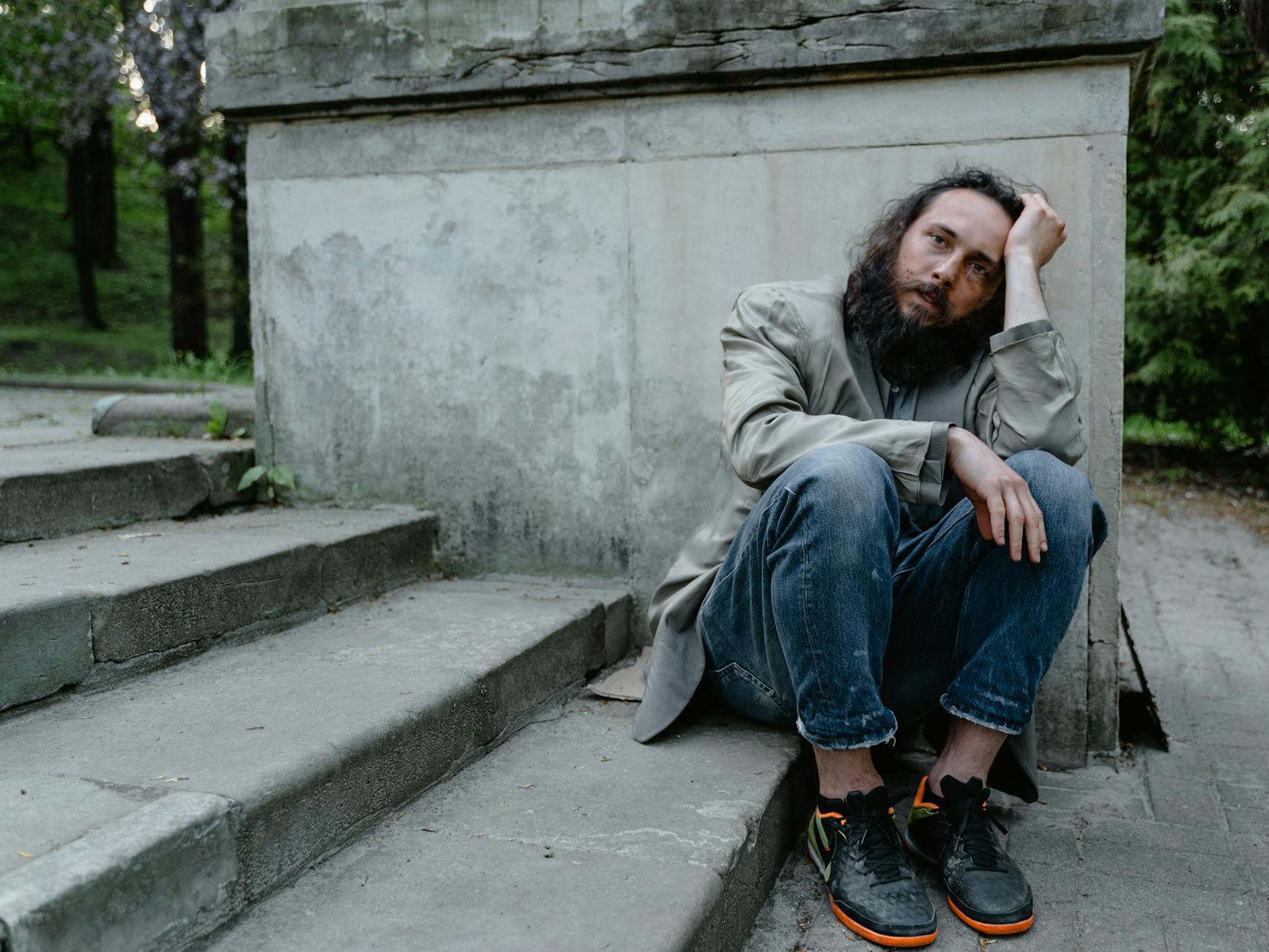
A few years ago, I was on the south bank in London, near Waterloo station, and I got talking with a homeless man called Richard who had approached me asking for money.
He was in a bad state. As we spoke, he rolled up his sleeves and trousers to show me the worst open wounds on his arms and legs that I have ever seen. Richard was a drug addict and his wounds were caused by injecting sites which had got seriously infected.
Resigned
I told him what he already knew: these wounds were life-threatening. I urged him to go to the nearby St Thomas’ Hospital and offered to go with him, but he was not interested. He seemed resigned to his fate.
But, even after he knew I would not give him any money, he did want to talk. And he proceeded to tell me about his family background and the abuse he experienced which had triggered his life falling apart, and his descent onto the street.
Forgiveness
Quite out of the blue, he asked me starkly:
‘How do I find forgiveness?’
I explained what I believe about God’s offer of forgiveness through Jesus, which is available for everyone, whatever they had done and whatever the situation. And then he asked me to pray for him.
So sitting on a wall by a busy pavement, I prayed the Lord’s Prayer with him.
“Forgive us our sins, as we forgive those who sin against us”
‘The right words’
After I finished the prayer, Richard mumbled Amen. But then there was a further request: he asked me to write down the words of the prayer for him, as he put it
“so that I have the right words to say”.
I ripped a page out of my notebook and wrote down these ancient words in block capitals as neatly as I could. I handed it to Richard and he folded it and put it in his pocket. We shook hands, said goodbye and after a final plea from me for him to go to hospital, he shuffled off.
Spiritual needs
I don’t know what happened to Richard. But I’ll never forget that conversation.
What struck me forcibly was that as well as his desperate physical and medical needs, Richard had such deep spiritual needs. He was seeking a form of restoration that social and health services alone could not provide.
He was seeking grace. Something which could bring him consolation and forgiveness in his overwhelming grief and lostness.
Conviction
And, along with many other experiences, that encounter influenced my conviction ever since to integrate the practical and spiritual aspects of care, and to resist the secularising trajectory of so much social action.
It was this belief that took me to work for Hope into Action where we overtly aim to embody both professional excellence and spiritual passion in everything we do as we work with churches to house people who have been homeless.
Last week
And just last week, I was reminded again of the importance of this at the community meal we run at my church each Wednesday evening called The Vine.
It had been a busy evening. Some volunteers got held up, the oven was not heating up properly, the meal was delayed and there were a few hassles to deal with. And towards the end of the evening, a man came in (I’ll call him Tony) who we know well but who we have not seen for ages.
Heaviness
Tony loitered at the entrance, looking a bit embarrassed and apologetic. We welcomed him in and served him one of the last meals.
As we sat together, he explained some of the health and relationships difficulties he was facing. You could sense the heaviness of what he was dealing with, so as he finished eating I offered to pray for him and he readily accepted.
‘It’s about grace’
We moved to the side of the room and Tony explained he not come recently because “I have been working and I know this meal is just for people with no money.”
I said to him that we never say who can or can’t come to the meal – it’s for anyone who wants to come. I said to him, ‘It’s about grace’ and I instinctively put my hand on his shoulder. And when I did this, it seemed to release something within him. He sighed deeply, and in that crowded room, started crying.
And as we sat there, I prayed for him to know God’s grace in all he was facing. And after I prayed, he put his hand on my shoulder and prayed for me.
Spiritual food
I was so glad that our church community can offer a warm welcome and a hot meal to people like Tony. It’s a practical expression of grace.
But too often in Christian social action, the practical obscures the prayerful. Our nervousness or reticence often allows church-based community projects to drift in a secular direction.
As well as real food, the church needs to offer people spiritual food as well. To share actual bread and ‘the bread of life’, as Jesus describes himself in John 6:35. After all, that’s our main job.
As Ann Morisy wrote in Beyond the Good Samaritan (1997):
“People have spiritual needs, and if churches do not help people address these needs then few other agencies will. Churches have often been duped by our deeply secular culture into providing welfare for those in need without being clear about how this helps the Church fulfil its primary task. There are other agencies which provide care for those in need, but no other agency other than churches has the task of helping people do business with God.”
Hope into Action Conference: Last year, 60% of Hope into Action’s tenants wanted to be prayed for and 14 took the step of being baptised. All are welcome at our conference on 20th May.
Next week, I am facilitating a seminar at the ChurchWorks Summit titled Semi-skimmed Beliefs or Full Fat Faith? Investing in your Christian Distinctiveness.
Discover more from Grace + Truth
Subscribe to get the latest posts sent to your email.

 Grace + Truth
Thank you very much for this, Jon. It is moving to read. There is a parallel to this at St. Mark’s, Gabalfa, Cardiff, a poorer area of Cardiff. A former youth worker, Marcus Nelson is now Vicar there, married to Della. They provide spare foods from supermarkets three times a week. But before these provisions are made available, there is encouragement to come into church for a quiz, testimony, a Bible reading and message. This is lovingly planned. Della looked at what other churches were doing, and prayerfully has followed a different pattern.
LikeLike
thanks Graham. Sounds interesting – do send this onto Marcus and Della if they would find it interesting. Thanks!
LikeLike
Jon, as always I want to thank you so much for this post. Keep doing the good stuff you are doing, even when it’s tough.
LikeLike
thanks John – hope the new job is going well. Take care and love to Jeannie
LikeLike
Well done Jon, being available, seeing, listening and acting in the situation.
Stuart Townend’s hymn “How deep the Father’s Love” verse 3
3 I will not boast in anything, no gifts, no power, no wisdom; but I will boast in Jesus Christ, His death and resurrection. Why should I gain from His reward? I cannot give an answer, but this I know with all my heart, His wounds have paid my ransom.
Quoting from 2Ti 1:8-9 So do not be ashamed to testify about our Lord, or ashamed of me his prisoner. But join with me in suffering for the gospel, by the power of God, who has saved us and called us to a holy life not because of anything we have done but because of his own purpose and grace.
The “J-word” in action!
Jon
LikeLiked by 1 person
Thanks Jon. The ‘J word’ lives on!!
LikeLike