
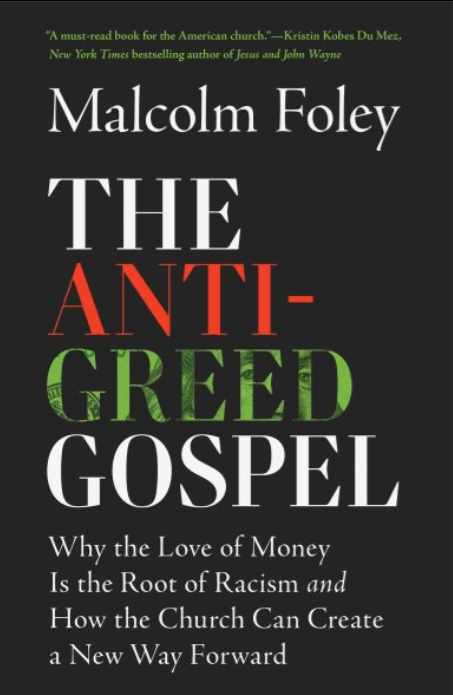
Review of The Anti-Greed Gospel: Why the Love of Money is the Root of Racism and How the Church Can Create a New Way Forward; Malcolm Foley (BraznosPress, 2024)
On a flight to New York last year, I watched Martin Scorsese’s film Killers of the Flower Moon. It is a grim tale about Native American women in the 1920s who become extremely rich when oil is discovered on their land. Many marry white men but then become ill and die in mysterious circumstances, and their husbands inherit their wealth.
The movie’s plotline is a perfect illustration of the problem that historian-pastor Malcolm Foley identifies in his book, The Anti-Greed Gospel:
“Race and racism are not fundamentally about hate or ignorance, they are creations of greed. And they always have been.”
Economic greed
European businessmen did not enslave Africans because of hate or ignorance but because they could make money from them. Similarly, the US Southern states fought passionately to maintain slavery because it was the economic powerhouse which made their plantations profitable.
The root of racism is economic greed:
“Race and racism were created because some people wanted more resources, wanted them cheaply, and were willing to do whatever it took to accumulate these resources.”
Lynching
Another example he analyses is the barbaric lynching of black men, so prevalent in the US in the post-civil war South. The activist Ida B. Wells emerges as a hero in the book because her brave research exposed the economic drivers of the practice: lynching was designed to create the fear to quell dissent and protect the economic status quo.
And Wells’ clarity about greed being the core problem directly informed her strategies to fight it:
‘The white man’s dollar is his god…the appeal to white man’s pocket has ever been more effectual than all the appeals ever made to his conscience.’
Wells’ activism to encourage black people to move away from areas where lynching was rife was more effective than any other forms of protest because it reduced the workforce and hit the ‘white man’s pocket’.
Race itself
And Foley goes deeper than racism. He argues that the whole concept of race itself is a construct designed to give economic oppression a twisted form of ethical and theological legitimacy:
“Contrary to popular opinion, race is not primarily about skin colour but about people seeking to categorise one another in order to exploit them. It is about greed.”
Exploitation starts the cycle of oppression, violence maintains it and concepts of race justify it.
The spiritual battle
A core strength of Foley’s book is its vibrant and passionate theology. He does not simply think the gospel simply provides a powerful archetype of generosity or a philosophy of social justice. He believes in the spiritual battle and the power that the idol of wealth can hold over our lives and society. He takes Jesus’ words in Matt 6:24 seriously:
“You cannot serve God and Mammon”
As Foley points out, of all the ancient gods he could have picked, Jesus specifically selects Mammon which represents the spiritual power of wealth and greed which we easily shape our lives around:
“Why say “Mammon” instead of “money” or “riches”? And why capitalize it?…We are talking about idolatry. Pleonexia, the Greek word variably translated as ‘covetousness’ or ‘greed’ in the New Testament, is the evil at root; the constant desire for more, the drive to accumulate.”
And he challenges a contemporary church which is too complacent about the dangers of wealth:
‘Much of the Western tradition sees wealth and riches as a tool and boon to steward; Jesus frames them as enemies to be defeated.’
Bold and provocative
The Anti-Greed Gospel is a bold and provocative book about how the idolatry of greed underpins social injustice. I will end with these two thoughts:
Firstly, The Anti-Greed Gospel shows why we need to anchor social justice in the political economy. As I have argued before, we need to disentangle social justice from the toxicity of identity politics. The focus should be on the concrete matters of health, affordable housing, decent wages and a more fair distribution of wealth. We need an earthy, integrated spirituality which challenges the excesses of ‘market forces’ and argues for the Common Good.
Secondly, it made think about my work with Hope into Action and especially our role in attracting investment for homes for people who have been homeless. All homeless charities have a ministry to those affected by poverty, but we also have one to those with wealth. In 2010 Ed and Rachel Walker invested £30,000 of their own money to help buy Hope into Action’s first house. In the 15 years since, we have seen a thousand-fold increase and have seen over £32,000,000 invested in homes for people who would otherwise be homeless.
It is a great example of people prepared to put the Anti-Greed Gospel into action.
Buy: The Anti-Greed Gospel by Malcolm Foley
Discover more from Grace + Truth
Subscribe to get the latest posts sent to your email.

 Grace + Truth
Jacques Ellul who first taught me that the language of stewardship was not appropriate for money and wealth. God did not create money. Mankind made it. Graeber’s mastery book “Debt. The first 5000 years” chimes with this article too.
LikeLike
Thanks Semper! I have only read a little of Jacques Ellul, but I often think I should read more. Thanks for the other book recommendation too.
LikeLike
Jon, I will bookmark this post for another day. The book looks fabulous but my reading list is enormous at the moment! Thanks so much for the review.
Huw
LikeLike
Yes, there is probably a good deal of irony in spending too much money on books about greed and poverty! Its a short book but packs a real punch and some of Foley’s insights are very uncomfortable – but then so was Jesus…
LikeLike
of course
LikeLike
Do you see all that commentary about racism and race itself as being rooted in greed just as obvious?
LikeLike
Yes.. Transatlantic slavery started mainly because of European and British merchant’s greed, and the social construction of race and the supposed inferiority of African, Asian and native American peoples was invented to justify Empire, slavery and genocide.
LikeLike
of course this is basic and central to the gospel, greed is a major sin / idolatry. And it clearly underlies a lot of historic racism and oppression. As you know I still sympathise with a lot of Marxist analysis, economics is always a key driver.
however I struggle when the argument is framed almost entirely around trans Atlantic white supremacy and black resistance to it. Greed is international and universal across humanity. Currently greed and exploitation needs to be challenged in India, China, the Gulf, Africa and in the diasporas in the UK as well as in the white west, and within our own lives.
It often leads to othering and dehumanising oppression. But in a complex and intersections world it is not just about white racism.
LikeLike
Yes – the book is focussed in the experience of Black Americans but I think this is a global issue. It has most come home to me seeing the racist attitudes faced by Phillipinos by people from Singapore and Hong Kong because this is not an issue of colour of skin or ‘race’ as they cannot even tell which country people are from – but there is discrimination based on people’s perceptions of the people from a certain nation. Thanks Greg
LikeLike
Like wise I could tell numerous stories of Indians and Pakistanis exploiting and mistreating poorer people of their own national backgrounds, as well as random others.
LikeLike
I appreciate the review!
LikeLiked by 1 person
Thanks Malcolm – good to be in touch and thanks for your book! I heard you interviewed on the Holy Post. All the best and God bless you in your work.
LikeLike