In these polarizing times, what kind of voices do we most need to listen to? Those who simply affirm our own sense of righteousness? Or those who challenge our own blind-spots and urge us to think more deeply?
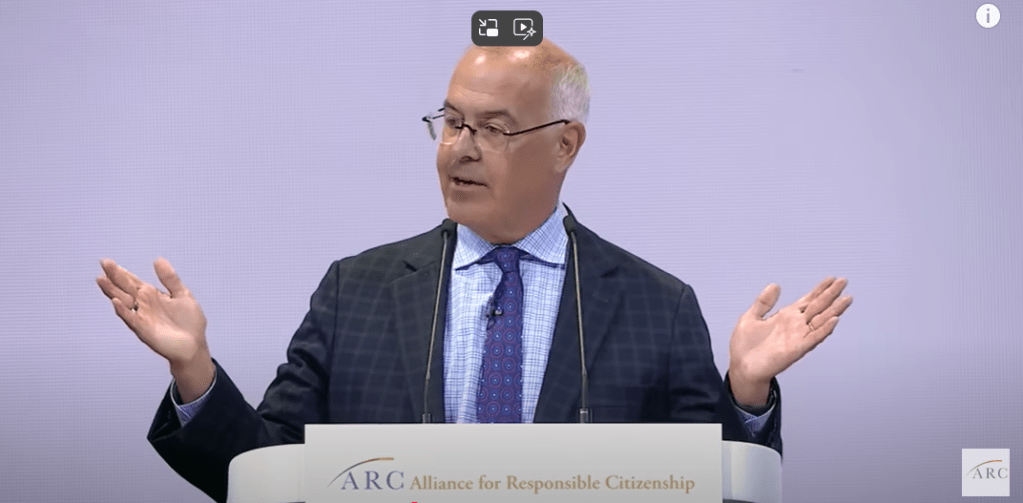
This week the conservative journalist David Brooks gave a masterclass in the kind of public communication that we most need at the the Alliance for Responsible Citizenship (ARC) conference in London.
‘Educated elite’
He softened up the right-wing crowd with humour and self-deprecation as he confessed he was one of the ‘educated elite’ which the contemporary right loves to belittle.
But then he launched into a sharp critique of the moral, cultural and political disaster of what Donald Trump is doing.
“I have a lot of sympathy with what drove people to vote for Trump, but I’m telling you as someone who’s on the front row to what’s happening, do not hitch your wagon to that star.”
Anti-left
He argued that whilst Trump, Musk, J.D. Vance and Pete Hegseth are viewed as populists they actually are all Ivy League graduates who represent the destructive self-interest of the educated elite.
They do not stand for truly conservative values at all. They are simply anti-left. They have no positive vision for society but are simply hell-bent on destroying the institutions they see as left-dominated and woke.
And they are tearing down institutions which have been formed by Christian beliefs:
‘They are destroying Judeo-Christian faith…based on service to the poor, service to the immigrant, service to the stranger…conservative evangelicals in government who want to fight sex trafficking, poverty, they want to preserve national security. Donald Trump is declaring war on those Christians”
Going deeper
In response, Brooks was applauded, booed and even heckled as a ‘traitor’. But this was brilliant public theology.
Not simply because it is well-argued but because he was willing to take on the room he is addressing, to resist the shallow seduction to crowd-please and instead go deeper in the name of truth.
Moral formation
And Brooks goes deep because he speaks personally. He speaks about the importance of soul-craft: that moral formation must be at the centre of cultural renewal. In the face of challenges and hardship, will we be broken or broken-open?
As Glen Scrivener put it in his superb commentary on Brooks’ talk:
“Suffering breaks you open, love breaks you open. And love in the midst of suffering is what really breaks you open and will heal you. And this is the Christian gospel. We are not those ascending a mountain by our own virtue but we are in a valley of deep shadow and the good shepherd has joined us there to love us.”
Roots of faith
We need to listen to the voices of people like David Brooks.
Rather than swinging between left and right we need to go deeper. Real life involves balancing tensions which are lost in the contemptuous polarization of the culture wars. Those, like me, who are on the left, need to accept the strengths of conservative perspectives.
Instead of shallow nostalgia about ‘re-claiming Christian values’ we need to understand that the fruits of faith are not produced without the roots of personal conviction. As he puts it:
“Culture changes when a creative minority find a beautiful way to live. Culture changes when a small group of people find a better way to live and the rest of us copy. That’s the story of the early church.”
Jesus was far from a populist. He challenged those who followed him and most deserted him. But he inspired a small group of followers who changed the world forever. Let’s follow this way – and lets be prepared to be both applauded and heckled for what we believe.
Please take 15 mins to watch David Brooks’ talk at ARC or read the transcript:
Discover more from Grace + Truth
Subscribe to get the latest posts sent to your email.

 Grace + Truth
Thanks Jon,
A super comment on a super speech. As a truly Christian conservative he could sympathise with some of the reasons people voted for Trump, but he could also deliver a devastating critique of Trump’s anti-Christian attitudes and policies. It’s a great example of a Christian calling attention to the true Christian values that can underpin distinctive political leanings and being prepared to upset or divide those who listen because of convictions that transcend worldly politics. He showed a lot more courage than many church leaders, sadly, who only ‘play to the gallery’.
LikeLiked by 1 person
thanks Martin – yes the dangers of ‘playing to the gallery’ are always there. I find this when I speak at conferences and the nagging fear for people to like and affirm what you share can limit what you say. I think this is why i find dialectics helpful (e.g. grace and truth) and framing things in terms of ‘tension’ between poles. People often find one pole they are more sympathetic to but then can see that holding another emphasis is valid. Of course there is a danger of ‘mushy centrism’ but I believe that truth is found in holding tensions together.
LikeLiked by 1 person
Jon, thanks so much for posting this. Really interesting to reflect on Brooks’ talk, and one of the best expositions I have heard on how and why Conservatives hardly conserve anything any more. The ability to conserve the good we see (I liked the reference to Burke’s comment that we should operate on our country the way we operate on our father) is crucial, but (linking it to Luke Bretherton’s talk at T4CG on Wednesday) depends on what we see as goods and therefore worth the patient effort to conserve.
LikeLike
Thanks Huw – yes it does. But I think there is plenty of things we can agree are good that we can start with – stuff like democratic process, care for vulnerable, the sanctity of life, care for the family, meaningful employment, decent health care and equitable housing?!
LikeLike
Jon, I maybe less optimistic than you about what we might agree on! Within British Conservatism I see serious doubts about democratic process and equitable housing, for instance.
LikeLike
Thank you Jon for this piece. In ecumenism gathering around those issues on which we all agree is simple and may have some value. The deeper work comes from gathering around those issues on which we most passionately disagree and do so in love, honour and respect. When we do this, we make ourselves most open to the transforming work of the Holy Spirit who calls us to unity not conformity. +Marianne Budde spoke challenging but loving words to which President Trump could only respond with negativity. And so St Paul observes “For we are the aroma of Christ to God among those who are being saved and among those who are perishing; to the one a fragrance from death to death, to the other a fragrance from life to life.”
The Revd Anton Muller, County Ecumenical Officer, Churches Together in Lancashire
LikeLike
thanks Anton – appreciate your comment. Yes, I hope that a hallmark of truly Christian discussion is being able to talk well about areas where we most strongly disagree. I think the realisation of ‘grace’ should enable us to passionately discuss what we belief ‘truth’ to be and avoid de-humanising people in the process. I fear that too often church culture is too brittle and not robust enough to discuss issues well. We settle often for a cheapened form of grace which skirts over problems rather than really faces them.
LikeLike
“Defiant humanism” — what an extraordinary phrase, and how apt in this time of polarisation and cultivated hatred. Jon, thank you so much for this post, and bringing this talk to our attention; I’d likely never have found it otherwise. It is a truly wonderful message, a true speaking of truth to power. It brings to mind a description of a political identity that I think many of us can connect with these days—especially those from socialist roots who feel deserted by the left: “socially conservative and fiscally socialist”. Social conservatism is rooted in Christian values, while the new left society values seem to embrace and encourage secularism, and even the new Dawkins-influenced brand of fundamentalist atheism. We certainly need more voices like David Brooks, brave, compassionate, non-polarising voices.
LikeLiked by 1 person
Completely agree. The courage to be “socially conservative and fiscally socialist” might be the thing our lives, our communities and our planet most needs…
LikeLiked by 1 person