In his autobiography, the legendary footballer Bobby Charlton wrote about the material poverty he grew up in a North East of England mining community in 1940s. He records how everyone in his neighbourhood would be hungry the two days before pay-day because everyone was surviving on just bread and margarine.
Charlton describes the insecurity and horror of the miner’s existence and avoids any nostalgic romanticising of the past. But he does continually remind the reader of the strengths of his upbringing: the richness of relationships within family and neighbours and the strong identity forged within him by his proud, working class community. As he puts it:
‘the pangs of hunger were never accompanied by the impoverishment of not being surrounded by people who cared passionately about your wellbeing.’
A different story
Katriona O’Sullivan’s best-selling book Poor tells a very different story. It’s a gripping and shocking account of her life growing up with two parents with chaotic addictions to drugs and alcohol.
The early chapters read like someone brought up in a real-life version of Trainspotting. Her childhood home was filthy, there was little food and people continually in and out of her house to deliver and use drugs. She witnesses her Dad go to prison and her Mum drawn into prostitution.
“There are no words I can find to describe how low my parents were at that time, or how it felt as a kid to see them struggle, strung out, losing all sense of how to live. Two ghosts in the house, shells of my parents with nothing inside. We were too, us kids, little empty things with no nourishment, no love or food. We would wander around our house surviving, needles lying about, people coming and going.”
Criminally abusive
Her experiences are both traumatic and criminally abusive. She watches in horror when her drug-addled Mum gives birth to a baby right in front of her. The worst episode us when one of the regular visitors rapes her when she left alone with him. Afterwards, she tells her Mum but she just replies ‘yeah…well he raped me too.’
What struck me most about Poor is that the material poverty it describes is always linked to the poverty of relationships O’Sullivan experienced and the negative sense of self-identity this caused. It contains very little commentary about the economics of poverty: low pay, unemployment, benefit entitlement, underinvestment or the power of big corporations.
Poor relationships and identity
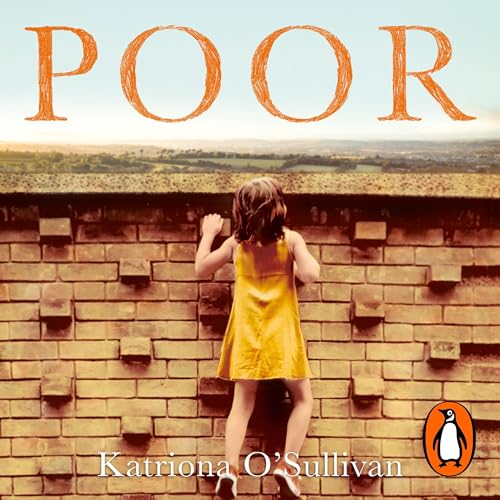
The front cover depicts a young girl climbing a brick wall – but the metaphorical wall described in the book is not chiefly structural or economic but one caused by the dysfunctional relationships she found herself raised within .
It is a sharp contrast from the poverty described by Bobby Charlton. His sporting talent enabled him to escape the material poverty of his upbringing but his life was enriched by the relationships and identity he was born into.
In complete contrast, the relational chaos and abuse that O’Sullivan experienced left her with a deeply negative self-identity that she struggled to overcome. She lists these as:
Pissy pants. Smelly. Dirty child. Trash. Thick bitch. Mouth. Gymslip mum. Sponger. Waster. Common. Slut. Slapper. Stupid. Stupid. Stupid. Stupid.
Route of salvation
For O’Sullivan, education provides the route of salvation. Through a higher education access programme, via many ups and downs, she starts a psychology degree and her talent shines through. She ends up with a doctorate and becomes a Professor. She finds a new identity based on her educational achievements and her closest relationships:
PhD.
Daughter. Wife. Mother.
In many ways, Poor is more a personal story than a political one. O’Sullivan’s individual journey is summed up by the book’s sub-title: Grit, courage, and the life-changing value of self-belief.

Holistic perspective
Books like Poor expose the texture of contemporary poverty. We need a holistic perspective which appreciates that poverty runs deeper than just a lack of resources.
As O’Sullivan puts it at the end of the book:
“Being poor affects everything you do and everything you are…Of course, it is the lack of money and material possessions…for so much of my life I literally had nothing. But ‘poor’ for me was also feeling like I had no worth. It was a poverty of mind, poverty of stimulation, poverty of safety and poverty of relationships.”
A new vision
And the challenge is that these forms of poverty cannot be addressed by the government and policy-makers alone. Governments can allocate resources, a vitally important factor, but they cannot restore relationships or rebuild people’s identity.
This is where our rich but needy nation needs a new vision to guide us: of justice and greater equity of resources but also of relational commitment and stronger communities. We can find inspiration in the ancient vision that Isaiah speaks of (58:12):
“Your people will rebuild the ancient ruins and will raise up the age-old foundations; you will be called Repairer of Broken Walls, Restorer of Streets with Dwellings.”
- Buy Poor by Katriona O’Sullivan
- Hope into Action’s conference on 12th March 2025: Restorers of Hope
Discover more from Grace + Truth
Subscribe to get the latest posts sent to your email.

 Grace + Truth
What an excellent and thought-provoking piece of writing. Thank you, Jon.
LikeLike
Thanks Sharon – much appreciated.
LikeLike
As always, you’re worth reading. Thank you.
Peter Randall SJ
LikeLike
thanks for reading and commenting Peter!
LikeLike
Thanks, Jon, for describing the startling contrasts between the experiences of poverty by Charlton and by O’Sullivan. I suggest another kind of poverty – in addition to the poverties of relationships, resources and identity – is the poverty of purpose. By that I mean a lack of any greater meaning to life beyond survival or escape. Maybe it is included in what you mean by poverty of identity. Perhaps O’Sullivan implies a poverty of purpose when she talks about ‘poverty of mind…of stimulation’. Later she found a purpose through education. But what about a spiritual dimension to it? Faith expression and nurture – or lack of it – is, I think, an under-valued, but important, component in a person’s experience of poverty. David Graham
LikeLike
Thanks David for reading and commenting. Yes, I would include purpose, along with aspiration and hope, within the identity group. What I have found is that it is a key aspect of your ‘relationship with yourself’ – how do you perceive your own value, both now and going forward. So many of us are privileged to believe that we have purpose and meaning and this is huge in terms of how we see ourselves.
I think all three are deeply spiritual – and most of all the identity one. How we use and share our resources is spiritual, how we relate to those around us and how we treat others is deeply spiritual. And of course, how we view ourselves and our relationship to God, is the most critical spiritual question.
LikeLike
Do you think there is such a thing as a ‘poverty of opportunities’? Is that what O’Sullivan might mean by talking about a ‘poverty of stimulation’?
LikeLike
Yes I do. It’s a key reason why I am opposed to private education because it basically is a way for more wealthy people to buy opportunities for their children denied to the rest.
A povery of opportunity could be a separate circle but I think it derives from the combined impact of the poverties of resources, relationships and identity. Bobby Charlton had a combination of raw talent and the relationships and identity to propel him to the top of his profession by taking hold of the opportunities he had. Likewise, stimulation comes from the benefit of being brought up in an environment which encourages and nurtures ambition and engagement with the world and looking outward – all of which relate to relationships and identity.
LikeLike