Note: This poem was uncomfortable to write and may be uncomfortable to read. It holds together voices that clash — bishops, marchers, migrants, parishioners — in order to lament the fractures of our nation and to seek Christ at the centre. The discomfort is part of the truth.
Thomas, parish priest,
opens the Bishop’s statement on his screen:
“We are deeply concerned to hear of the planned ‘Unite the Kingdom’ march in London this weekend.
Though framed as a celebration of free speech,
it is inextricably linked to voices and movements that have previously contributed to division and racial intolerance.
This is at odds with everything we, and millions of Londoners, stand for.”
Concern,
yes.
Division,
yes.
But Thomas wonders:
is this unity,
or another line in the sand?
Words that claim to heal,
but leave the fracture exposed.
On Sunday he hears both refrains:
“We can’t cope — too many migrants,
our town is overwhelmed.”
And in the same pew:
“Welcome the stranger.
And anyone who disagrees — far right.”
The Bishop’s words return,
like a refrain in his head:
“We affirm that freedom of speech is a vital democratic right, and at the same time pray for a nation
where that freedom is exercised not to deepen fear or exclusion,but to foster compassion and unity.”
Compassion.
Unity.
Yes, Lord.
But what of the voices he hears tonight?
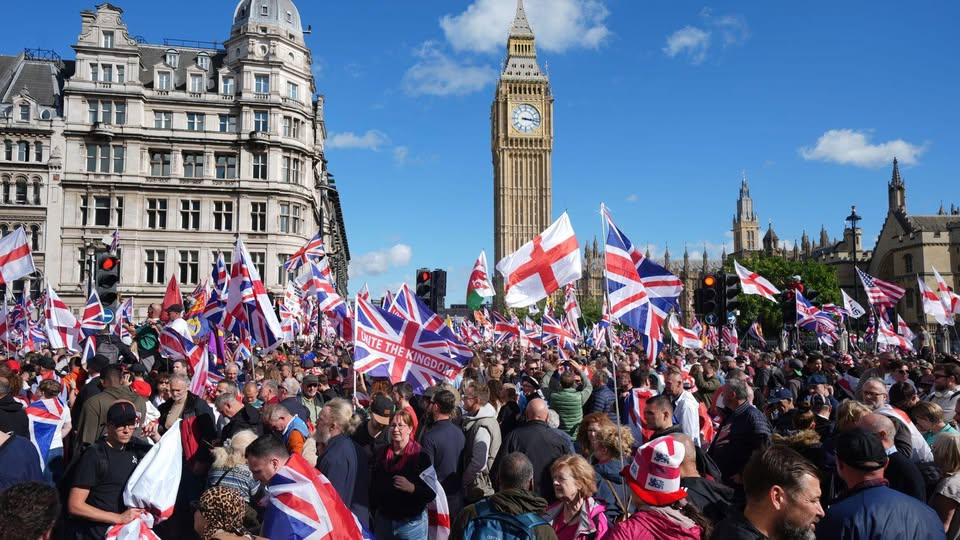
On YouTube he sees tens of thousands march,
flags wave, chants crash like waves.
And among the banners,
signs about Jesus:
“Jesus Saves,”
“Jesus is King.”
A chant rises:
“Jesus is King! Jesus is King!”
But then — twisted,
cut through with bile —
“Starmer is a #%€*^’
Christ’s name invoked as cover,
a chant of worship
spliced with hatred.
Thomas shudders.
Which Jesus is this?
Not the crucified one.
Not the refugee child.
Not the lamb who takes away the sins of the world.
The mic swings closer:
“I’ve grafted all me life,
can’t heat the flat — no one listens till Tommy shouts.”
“We’re not racist, just ignored.
They’ve forgotten us.”
And then the sting again:
“This is our country.
Send them back.”
Thomas exhales.
The wounds are real,
but the chant is not Christlike.
Never Christlike.
The Bishop’s voice again:
“Every day, in our churches and on our streets,
we see a very different city…
One where people from all cultures, religions, beliefs and classes
can work, worship, and live together.”
Yes, Thomas thinks,
but also no.
For in his church he hears fracture,
fear, anger, welcome, hope —
all mingled.
Not a simple city,
but at times a divided people,
held uneasily under one roof.
He scrolls again:
counter-protestors penned in,
shields shudder,
stones fly.
The city trembles.
And beyond the livestream,
another crisis swells —
fields fail, seas rise,
creation groans.
How small our slogans,
how vast the storm.
The Bishop’s final words:
“We will hold all marginalised communities in our prayers this weekend,
and ask for safety, peace, and justice for all.”
Thomas kneels.
Yes, Lord. Safety. Peace. Justice.
But how? Whose?
And what does unity mean
when voices clash so fiercely?
He prays:
Christ, show us a unity
not crafted in statements,
not shouted in streets,
but broken in bread,
poured in wine,
birthed at your table.
Tomorrow at the altar rail,
Thomas will say,
“All are welcome.”
And they will come.
Samira and Ahmed,
refugees from Sudan,
their children fidgeting at the rail.
Gareth,
white van builder
taxed by emmision laws,
who went to the protest,
angry at politicians,
wary of migration,
doesn’t get climate,
yet hungry for Christ.
PC Evans,
eyes tired from long shifts,
still carrying the echo of pushing and shouting,
the press of the crowd in his bones,
holding out empty hands.
Arash, Iranian,
shaken from being spat at
on his way to church,
now kneeling, silent.
Eileen,
retired nurse,
NHS at breaking point,
who weeps for the cruelty of slogans,
yet prays for the marchers by name.
One bread.
One cup.
One Christ.
And Thomas whispers,
“Unite the church, Lord,
so that the world may yet
see another kingdom.”
Rev’d Jon Swales is an ordained C of E Priest who heads up Lighthouse, a fresh expression of church for adults battered and bruised by the storms of life. See his Cruciform Justice website and the Mission, Theology and Ministry on the Margins course he leads.
Jon will also be leading a seminar at the Hope into Action conference on 20 May 2026 Rooted: Homelessness Ends in Community
Discover more from Grace + Truth
Subscribe to get the latest posts sent to your email.


Thank you so much for this which captures and holds and highlights the tensions and the need to recognise that there are more voices than one that need to be heard by the Church
LikeLiked by 2 people
God bless you, Jon. And may HIS heart be known in ours.
LikeLiked by 1 person
Dear Jon,
Thanks for posting this- which captures some important things. I am writing as someone who comes from North Devon and lived in Manchester since 1982. I have volunteered in churches in a very deprived white working classes area and in a very culturally mixed & very deprived area. We now attend my parish church in in south Manchester where we have raised our family in an area which is 45% Muslim.
It has been too easy for progressives to overlook the deprivation and cost of living crisis in deindustrialised towns and coastal towns where the holiday trade has changed shape and other employment has declined. The church should be in support of those communities and share Good News with them. Expressing support for those communities can be controversial but should be heard.
However, we need to be very clear that white nationalism is not authentic Christianity. Stephen Yaxley-Lennon is very clearly far right. Reform are bullies and Neil Kinnock is correct to say that they use the fascist play book. The problems of our country are mainly caused by deindustrialisation, a dis-functional housing market and rising inequality. Scapegoating immigrants and the wider non-white community will not solve our problems and make the country worse. I do not want to see my friends, neighbours and colleagues of many backgrounds victimised. We had Reform campaigning here in the recent Gorton and Denton by election. Groups of 6 going around “canvassing”: a report of a neighbour’s teenage daughter feeling intimidated by the intense questioning; groups hanging around on our street, which is on the way to the local polling station, rather than the normal polling day operation carried out by established parties.
Church attendance has declined for 100 years with the exception of the immediate post WW2 period. This also cannot be blamed on immigration. The church needs ensure that it does not become co-opted by the hard right and far right as they seek to move culture ever further right. Being co-opted in this way would risk becoming like the “German church” of the 1930’s. We need instead to take note of the example for the Confessing Church of that period and stand against things that are wrong.
Kind regards,
Chris Rogers
LikeLike
Beautifully rendered, Jon. Different voices, conflicting ideas, even in the same voice. This is our reality.
“The discomfort is part of the truth.” How accurate this is. I pray to be able to hold the discomfort, to dwell there, as it seems at this moment in time, is God’s will for us. This too shall pass, but not through force.
LikeLike