
This post is taken from the 2025 Hook lecture ‘Prophet or Provider?’ delivered by Jon Kuhrt on 21st October at Leeds Minster. Read the full text here or watch the video below.
When it comes to responding to poverty, should the church play the role of prophet or provider?
Well, we should not accept the dichotomy between the two. I believe we need to find a truly prophetic edge based on practical experiences. As Ernst Trolsch wrote:
‘We theorise and construct in the eye of the storm’
We learn from being involved in real lives of real people. Everything I speak and write about has been learnt primarily from the front line of providing homelessness services for the last 30 years. These everyday realities are what has shaped my theological and political perspective.
We should be suspicious of academic theory or abstract theology which is detached from real experience.
Messy business of frontline work
We don’t need social action ‘prophets’ who have no experience of providing. However fluent they may be in talking, blogging or vlogging about social justice, their words need to be honed by the messy business of providing practical help.
Keyboard warriors will not inherit the kingdom of God.
But equally, we don’t want to become providers who become wedded to the status quo because of their vested interests in the charitable models of help or their government contracts. We must resist the cosyness to the powers that be which compromises speaking the truth.
What we need is prophetic providers.
Four examples
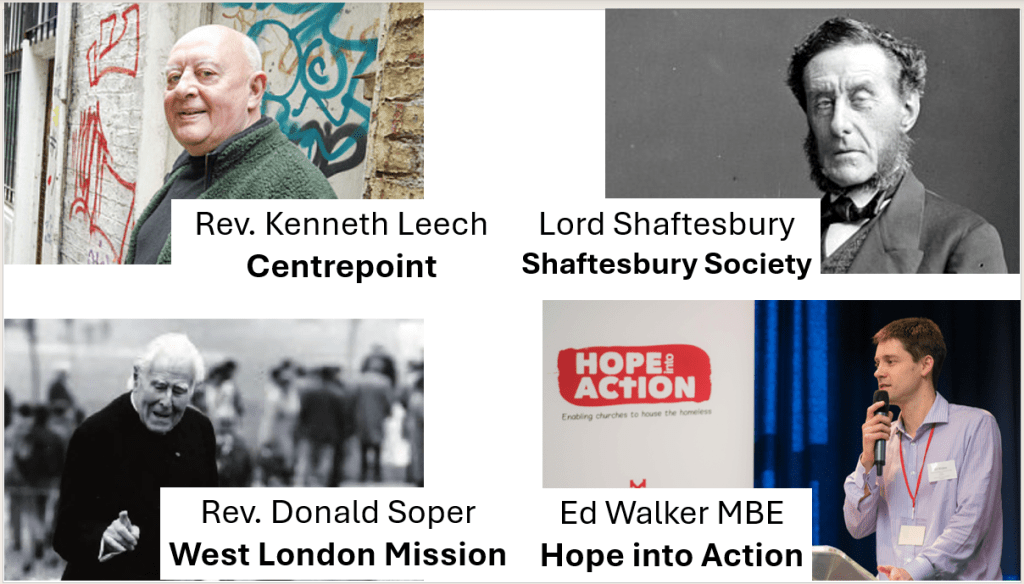
The best way to illustrate this is to speak about real people – and I think there is nowhere better to look than the four people who founded or led the four charities I have worked for:
Kenneth Leech & Centrepoint
In the 1990s I worked for the youth homeless charity Centrepoint, founded by Rev. Kenneth Leech, a socialist and Anglo-Catholic Anglican priest who was a curate at St Anne’s Church in Soho in the late 1960s.
He opened up the church’s crypt for homeless young people and they named it Centrepoint Soho as a prophetic statement against the huge office tower block called Centre Point just built at the top of Oxford Street but standing empty at that time for tax reasons. I became manager of the shelter on the St Anne’s site, read Leech’s books on sacramental theology and social action and got to know him.
Lord Shaftesbury & the Ragged School Union
In the early 2000s, I went to work for the Shaftesbury Society, a far older and larger charity which started life as the Ragged School Union under the patronage of the Victorian Lord Shaftesbury.
He was nicknamed the ‘Poor Man’s Earl’ because of his tireless political struggle for factory reform to combat the child labour. As well as his political campaigns, Shaftesbury also championed a whole host of practical Christian mission in the urban slums. He left an incredible legacy of mission churches, services and schools for disabled people. Many people do not know that the famous angel statue at Piccadilly, erroneously nicknamed ‘Eros’ is actually ‘The Angel of Christian Charity’, erected in honour of Shaftesury.
Donald Soper & the West London Mission
In 2010, I moved to the West London Mission, a Methodist organisation formed in the Victorian age which ran shelter for rough sleepers, bail hostels for prison leavers, homes for pregnant teenage mothers and even starting the first ever creche for working mothers. And much of this work was developed by Rev. Donald Soper.
Like Ken Leech, Soper was also an outspoken socialist who was famous for his robust outdoor preaching at Tower Hill and Speakers Corner. Over the course of his life it is estimated that he preached 10,000 sermons, and answered more than 250,000 questions. During the WW2 he was banned from broadcasting on the BBC due to his ardent pacificism and in the 1960s he became the first Methodist Minister to sit in the House of Lords.
Ed Walker & Hope into Action
And almost 3 years ago, I joined Hope into Action, formed in 2010 by Ed Walker. Ed came back from working in Africa with Tearfund and was struck by the homelessness in Peterborough. When he received an inheritance, he and his wife chose to use it to buy a house for homeless people and to partner with the local Baptist Church.
In the 15 years since, Hope into Action has grown into a Network of 131 houses across the country, all purchased by those who want to use their wealth as an ethical and impact investment. Our staff provide professional support and every house is partnered with a church who provide friendship and community.
Prophetic providers
All of these men were different: Soper and Leech sacramental socialists, Shaftesbury an aristocratic evangelical Tory Lord, Ed Walker a relatively young aid worker.
But they all had something in common: they each had prophetic vision for how the Christian faith could make a difference to poverty and homelessness in their era.
All 4 were providers who inspired and oversaw practical work which was anchored in their faith and a vision of God’s kingdom. They did not simply preach, write books or set up Think Tanks: rather their faith was incarnated and embodied in providing practical help to people on the margins.
It is this integration of practical action, prayer and politics which will make us prophetic providers. And this is what our wealthy but desperately needy country needs more than ever.
Read the full lecture text here or watch the video:
Discover more from Grace + Truth
Subscribe to get the latest posts sent to your email.

 Grace + Truth
I totally agree with you. I would never have joined Hope into Action 13 years ago (now retired) if it were just a campaigning organization, however worthy. We have to do something as well as say something. Recently I listened to a sermon on fasting, Isaiah 58, in which the thrust was that the kind (quality) of fasting that God requires is what will lead to justice and social transformation. No, no, no! God is saying that the fast he requires is going out there and “loose the chains” “break every yoke” ” share your food”. Why are we so blind? Sorry. Rant over. Preaching to the converted!! I agree, Jon.
LikeLiked by 1 person
thanks Noel. I think the dichotomy between what is considered ‘spiritual’ and ‘practical’ is so strong – whereas the bible is so much more integrated. It is most shown by our dis-integrated concepts of heaven being a ‘spiritual’ place where people float around on clouds – whereas the portrait of New Heavens and New Earth in Isaiah 65 and Revelation 21 are of heaven and earth being integrated and God being fully with us (as embodied in Jesus).
LikeLike