
Amos lived in the 8th century BC in a village called Tekoa. He was called to proclaim God’s Word to the political and religious elites of the time. This is a fictional imagining of the personal cost involved…and what this means for speaking up for truth today.
Tension
Amos was late home that evening from his extra work harvesting figs from the sycamore trees of Tekoa.
Once back, he could tell that something was wrong. Normally smiley and cheerful, his wife Miriam was quieter than usual. The plates were put down with more of a clatter than was necessary and little eye contact was made as the couple ate.
Amos tried to think what he had done. Meanwhile their two-year-old son Enoch continued to play on the floor with the toy sheep that his daddy had made for him.
Eventually Miriam snapped and revealed the cause of the tension.
Oracles
“In case you’re wondering”, she declared, “I discovered today what is in those oracles you’ve been writing. Yes, I’ve read them, Amos!”
“Oh,” replied Amos, drawing breath as he spoke. “Well, Yahweh has been revealing them to me, Miriam, and so I have to write them down”.
“It’s what you’re going to do with them that worries me,” his wife replied.
“What do you mean?” Amos responded nervously.
“You know precisely what I mean!” Miriam spat back. “Yahweh doesn’t reveal messages without expecting his prophets to deliver them. He’ll be wanting you proclaiming those messages! And then what’s going to happen?”
The King’s shrine
There was a pause as Amos summoned the courage to speak. “Well now you’ve mentioned it, Miriam,” Amos said slowly, “I’m going up north to Bethel tomorrow.”
“Bethel,” his wife repeated, trying to retain her composure. “The King of Israel’s shrine? Where Amaziah is priest? Why would you want to go there?”
“Because, Miriam, that’s the place where Yahweh has told me to speak his word.”
There was a pause, and for a moment Amos thought he was going to get away with it. Instead, Miriam exploded with tears.
Injustice
“So you’re going to Bethel, and you’re going to speak all that stuff you’ve been writing about Israel’s worship not being worth one jot to God whilst Israel is so full of injustice? All that stuff about God hating their noisy songs, all that stuff about the evil of their bribery and exploiting of the poor, all that stuff about Yahweh’s judgement soon coming upon Israel, all that stuff about him wanting instead for justice to flow like a river and righteousness like an ever-flowing stream?”
“Oh you read that bit,” Amos said trying to sound positive, “I was rather pleased with that.”
“I’ve read the lot!” thundered Miriam. “Do you think that for one minute Amaziah and King Jeroboam are going to put up with any of those things being said?”
True
“I don’t know,” Amos replied, “but God has given me these words and he expects me to speak them. It is all true, Miriam. You know it is.”
“I know full well it’s true,” replied Miriam, biting back the tears and cradling Enoch in her arms.
“But think, Amos, think! What good is it going to do, proclaiming that message? It may be true but they won’t listen if you just stride into Bethel and say it like this. You’ll simply put their backs up. They’ll hate it. And they’ll hate you! And what will happen then? Think of little Enoch… and me. Think of all the other things Yahweh wants to do through you. It’s surely important to play the long game on all this justice stuff?”
More positive
“Why don’t we read those oracles through this evening and tone them down a bit? Keep the challenge but put it more positively. Set a wonderful vision of future restoration and leave out all of that stuff about the terrible state of Israel at the moment”
“I’ll think about it” was Amos’ only response as they turned in for the night.
Calling or folly?
In the morning Miriam awoke to find herself alone. Enoch was still sleeping soundly, but Amos had gone. A brief message of his love was written on some of the parchment he had used to write the oracles that Miriam had read the day before.
As she looked down at little Enoch, she wondered whether her husband was showing the most amazing courage and faith in Yahweh…or the most stupid and irresponsible folly…
It’s easy to read the biblical prophets and admire their bold words against the injustice and idolatry of their day. But speaking out in a similar manner today involves a cost.
The safeguarding failures in the Church of England is an example. These cannot, and will not, be solved without confronting the truth about the church’s overall culture.
I know from personal experience that speaking this truth involves losing favour with those in authority and the advantages that come with this. It involves upsetting and disappointing those who love you and have your best interests at heart. It involves being presented as nasty, disloyal and arrogant. It involves having your personal weaknesses exploited and used as the reason for discounting the message you are seeking to speak. It involves dealing with threats to your job and livelihood.
But our society – and even more the church – more than ever needs people who can find the courage to accept this cost… and speak those words of truth that need to be heard.
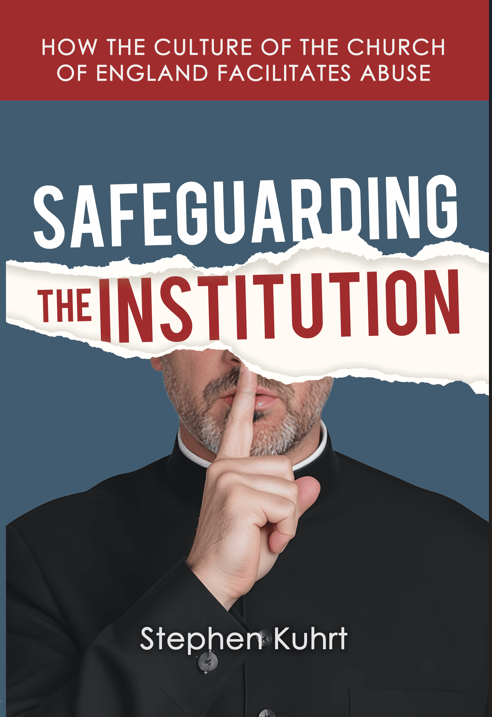
This article contains a section from Stephen Kuhrt’s book Safeguarding the Institution: how the culture of the Church of England facilitates abuse published on 18th September 2025.
Pre-order on Amazon. It will be available on other online stores after release.
For more about Stephen’s experiences see: A tale of two vicars: one exploiting the status quo & the other challenging it & his book’s website Safeguarding the Institution.
Discover more from Grace + Truth
Subscribe to get the latest posts sent to your email.

 Grace + Truth
Going by your previous post/s here, Stephen, I imagine you’ve written a bold book—it certainly has a very bold title! I look forward to reading it.
LikeLike
Thank you for inspiring me to have courage and refuse to cower. Powerful piece.
LikeLike
Well done… I fully agree.
LikeLike
Beautifully written. Such emotion in the interchange between Amos and his wife. It made me cry. Some of the tears though are from being told in one church that unless I was going to prophecy something positive and “nice” then to keep quiet.
Thank you for being inspiring
LikeLiked by 1 person
This is currently being played out in my own church setting where I have tried to do the right thing in the right way (safeguarding has been part of the issue but has not been the whole story – misuse of funds also features). Unfortunately, speaking up has not gone well at all. I have been accused of bullying by the leadership and asked to step down from volunteering roles without any opportunity to fully understand the “allegations” or respond to them. It is all being presented in a quasi-spiritual way too which adds to the injustice. What you have said here Stephen resonates hugely. The issue for me and otehrs like me is how to keep speaking out well and in a Christlike manner without sounding bitter or vengeful (which I am trying not to be).
LikeLike
I’m sorry to hear this Doug. Presumably this is at your church in America? There is more detail in the book about all the factors you mention – even if I mainly detail with their British (or more accurately English) characteristics. In many churches, people want it to be their oasis away from the problems of the world and if anyone is seen as being pro-active in raising difficulties, they are often treated in the way that you have been. The whole response is, largely subconsciously, designed to stop people in church ‘making waves’. And then, when terrible scandals over safeguarding or financial corruption emerge, people wonder how on earth this can happen in their church not realising they have colluded for ages with its causation. A lifetime in the church – and 22 years of ordained ministry – has shown this to me time and time again and this the very reason I wrote the book. The local church is just as much a problem here as the national structures.
If you feel you are getting nowhere then an open letter to the leadership setting out very calmly the issues and, crucially, the way they have treated you for flagging them up, is probably the way to go. They will undoubtedly respond by saying ‘its not the issues but the way you have raised them that is point’ but that will be rubbish. Vital to hold them to account but sadly you and your family will suffer as a result because nothing is more vicious than a challenged church subculture.
LikeLiked by 1 person
Thanks for taking the time to reply Stephen. It is so wonderful just to be heard and acknowledged.
As it happens, the church is very much in middle class England (although both my wife and I are working class Scots by upbringing and I do believe that our upbringing has contributed to our preparedness to speak out at times).
I very much wish I had had someone to discuss this with back in April/May. In early May we were required to relinquish all roles and to step back for four weeks while we “reflected and repented”, although we had sparse detail to reflect on and repent over. The Regional Minister (“Bishop” in Anglican terms) attended that difficult meeting and did not intervene even although I could sense he was disturbed by events. Following that demand of the leadership I did indeed send an open letter to the Minister and Elders copied to the members (it is a congregational church). Unfortunately I made the mistake of also resigning membership which I now realise has played into the hands of the ensuing “cover up”.
You were also correct to identify the “it’s way you raised the issue” deflection that is also being levelled at us but I am fairly confident that we did the right thing and in the right way. Since May some terrible messages have been distributed about us (our many friends who currently remain in membership have reported/forwarded them to us). Many of the messages are defamatory in nature and built on deceit or frankly untrue. The Regional Minister has even assured the membership that all policies were adhered to but that is not even close to the truth and, should anyone ever care to listen, I can easily prove this.
One lesson we take from this situation is how vulnerable we are to lies. People twisting the narrative is relatively easly to deal with given we usually have messages and e-mails showing a different reality. However, people making unfounded allegations is so much harder to deal with. Most folks seem reluctant to accept that church leaders might be deceitful and a form of “clericalism lite” applies.
The impact on us as a family has been significant from both a physical and mental perspective (my wife even wants to move house) but it has also impacted others including our weekly housegroup of 15 people, many of whom have since left the church, and many others besides.
I am keen to continue doing the right thing and in the right way (it’s what the Lord requires of us after all and what is this life if it is not a test of this?) but I also feel under pressure to halt the deceit (for the church’s sake) and slander (for our personal sake). If nothing changes or is acknowledged, who will every speak up again in this expression of church?
I have been in touch with the denominational structures but worry that their response will be more about smoothing everything over rather than getting to the truth. Certainly, nothing is moving quickly. We are currently more than 12 months into this nightmare.
If push comes to shove, I think I will write again to the whole church to explain the impact of the leadership’s behaviour. I have also been encouraged by many to take legal advice but I’m loathe to go down that road.
It does beg the question for me as to whether churches are able to properly hold themselves to account.
Thank you for speaking out and for being prepared to walk a very difficult road. I will be reading the book. Your speaking out provides hope and inspiration for others and will hopefully help move the culture in the correct direction. And we know the Lord will repay you for the years the locusts have eaten. I remind myself of this promise regularly!
LikeLike
Thank you very much for writing this book, Stephen, and praying that it will have a disturbing, yet reforming impact.
LikeLike
Whilst reading this, I couldn’t but be reminded of Bernard Randall. In a respectful and gentle way, and out of concern for students at Trent College, he preached a sermon underlining the legitimacy of a Christian understanding of gender, identity, and marriage.
In the aftermath of this, and despite his Christ-centred faithfulness, he has been disciplined by his Diocese and had his licence removed.
I have written to Libby Lane, Bishop of Derby, and urged her to have coffee with Bernard, to apologise to him, to pray with him, and to restore his licence. Have also written in the same vein to Malcolm, Bishop of Repton. Both without success.
‘Anyone who would live a godly life in Christ Jesus will be persecuted’, but it is deeply troubling when persecution is coming from the most unlikely quarter, in this case Derby Diocese.
LikeLike
Not directly related to Safeguarding, but if you want an example about how institutions can be changed, and even 800 year old laws overturned, with truth and determination in the face of being told change was impossible, then I’d recommend the 4 part drama “I fought the law” on ITVx.
LikeLike