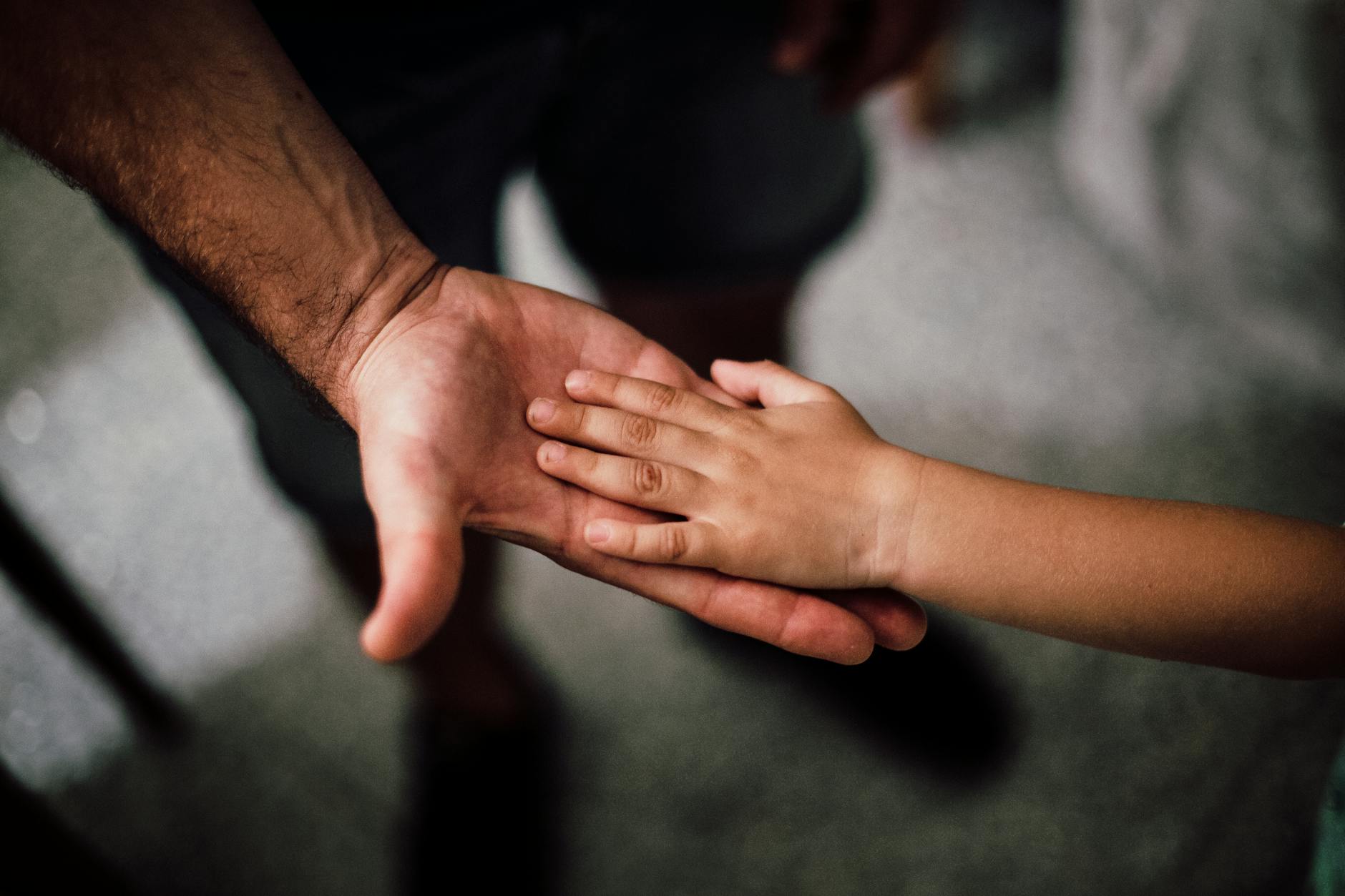
Every year, Father’s Day produces a dilemma for public conversations: how do you acknowledge the importance of fathers, without causing upset or distress to those who have had negative experiences? It’s a balance that churches grapple with every year on Father’s Day.
We need to be both sensitive and bold. We cannot avoid talking about the importance of fathers – its one of the most important social issues our country faces – but of course we do not want to rub salt into the wounds of those scarred by negative experiences. It’s a classic example of the tension between grace and truth.
Grace
The good fortune to have a good father is a complete gift of grace: none of us ‘earn’ a good father – it is a factor completely outside of our control.
Recently, my daughter was asked by a new friend ‘How often do you see your dad?’ The question came with an implicit assumption that it would not be very often. She replied ‘Every day…I live with him’.
The reply was poignant: ‘You’re lucky’.
And this is true, it does make her lucky. Having an ‘involved father’ makes a positive difference in almost every aspect of life chances. And 76% of young people in custody have an absent father.
We must speak with grace and care. There is no such thing as an illegitimate child – they are all precious humans of infinite worth. But the truth is that there are far too many illegitimate fathers.
Truth
The cost of absent fathers, who are either unable or unwilling to care and show consistent love for their children, is incalculable. I saw this ‘relational poverty’ most sharply when running an emergency hostel for homeless young people in Soho, central London.
Day after day, the biggest single cause of the endless stream of young people who made their way to us was relational. It was deeper than simply material poverty or a lack of resources, the chaos of homelessness and addiction was directly related to the dysfunction and abandonment within their families. Katriona O’Sullivan’s book Poor is a powerful case-study of this kind of poverty.
Commitment
We cannot speak meaningfully about the importance of fatherhood without talking about the importance of commitment. A father’s love to the mother of their children is never just an individual act of affection but a foundation on which secure lives are built.
My father, Gordon Kuhrt, had a profoundly challenging upbringing, affected by serious illness and being separated from his parents for most of his childhood. But I am deeply grateful to him for the consistency of his love to our whole family, and especially his 62 year marriage to my mum. He has lived out a maxim that he taught me:
‘The most important thing a father can do for his children is to love their mother.’
‘Freedom of choice’
But despite the clear importance of relational commitment, in our highly individualised and atomised society, speaking about marriage becomes controversial and those who do are easily accused of moralising. This is because we prize individual sovereignty so highly. ‘Freedom of choice’ has become an idol, the golden calf our society worships.
And this is why we are failing our children so badly: because individual choice is not what they most need. Children need relational commitment and the security and stability this brings. They need a better form of freedom, the freedom of commitment.
South Africa
At my church in Streatham, our new Pastor, Bruce Nadin, has spent the last 15 years living and ministering in South Africa, heavily involved in sports chaplaincy and prison ministry. Last week, he preached the best Father’s Day talk I have ever heard (link below).
He shared some tough truths about the impact that fatherlessness is having in South Africa where 65% of children do not have a father named on their birth certificate. The impact on young men, women and communities is catastrophic.
But he spoke with wonderful grace and hope that this is not simply a life sentence for those affected. All men can play a role in being father-figures to those who need them. He got all the men in the congregation to stand up and he challenged us all to be father figures to those around us.
Pain and healing
The response to his talk showed how vitally important this message was. So many men and women in our community carry scars and suffering from their experiences of fatherhood. It was moving to see so many bring their raw pain before our relational God and to seek his grace and healing.
This is what we most need in our fractured world: truth and reality about the problems we face and grace and hope for the redemption that is possible.
Watch Bruce Nadin’s great Father’s Day talk on 15th June at Streatham Baptist Church:
Discover more from Grace + Truth
Subscribe to get the latest posts sent to your email.

 Grace + Truth
Beautiful post, Jon.
“‘Freedom of choice’ has become an idol, the golden calf our society worships.”
So true, and so difficult to counter. Raising two daughters, now aged 12 and 10, we find it very challenging to balance their (especially the older’s) need for autonomy with family and Christian values. The force of peer pressure can be great. Parents don’t raise children, children do, said Judith Rich Harris in her book The Nurture Assumption. But that was in 1998. Nowadays she may write, parents don’t raise children, social media does. The force of TikTok and its ilk, even coming second-hand as it does to our 12-year-old seems to have immense power to direct choices and behaviour.
The twisting of positive self-confidence into “you can be whatever you want to be” drives identity politics and pretty much the whole social dilemma we face today.
Yet through all the difficulties, I focus on my great love for their mother, and hope to model a better tomorrow.
LikeLiked by 1 person
Thanks Toby – parenting is by far the hardest thing I have ever done. I feel comfort in knowing I can only do my best and then pray for them – and hope they find the good path and walk in it. Thanks for your encouragement and engagement and God bless you and your family.
LikeLiked by 1 person
Thanks Jon – for a great post, and link to a great talk.
These words jumped out for me: “But this is why we are failing our children so badly: because individual choice is not what they most need. Children need relational commitment and the security and stability this brings.”
I entirely agree, and it chimes with my research around children in foster care, where there is an emphasis on hearing and responding to the child’s voice (which is good) but very little on helping them to grow in love and relationship. I’d be interested in material you might have which fleshes out this idea.
LikeLiked by 1 person
This may interest some readers. The issue of absent father is mentioned at about 36 minutes
https://www.bbc.co.uk/sounds/play/m002dzzh
LikeLike