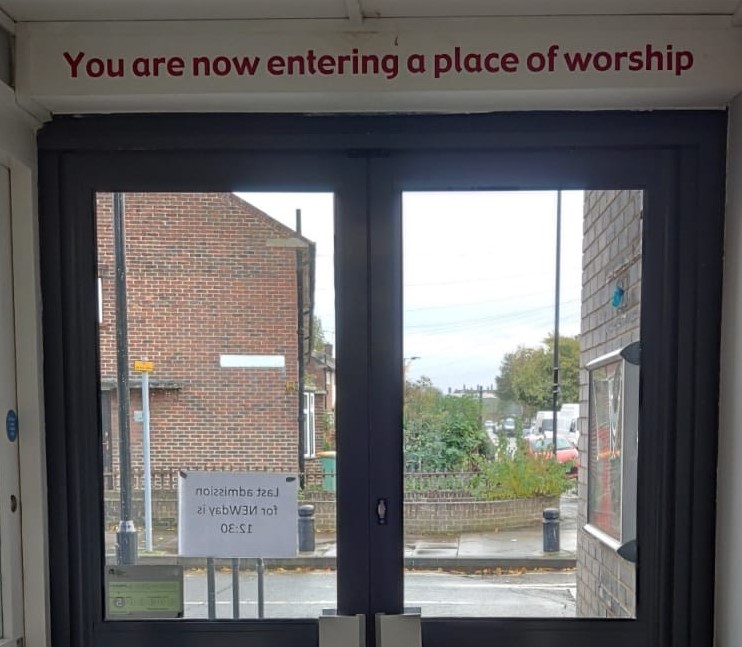
A while ago I visited a church in East London doing great work with people who are homeless and vulnerable. I saw these words above the inside of the door:
“You are now entering a place of worship”
At first I assumed it was the standard wording you see in religious buildings asking for respect. But then I twigged that it meant something quite different: these words are above the inside of the door so you only read them when you leave.
It’s a great reminder that everywhere is a place of worship.
What are church gatherings for?
The constant danger of religious activity is that it becomes something done for its own sake.
Churches can easily become social clubs which basically draw people together who like a certain style of spiritual activity. We become fluent in talking about God and singing and praying in ways that those gathered find comfortable and reassuring.
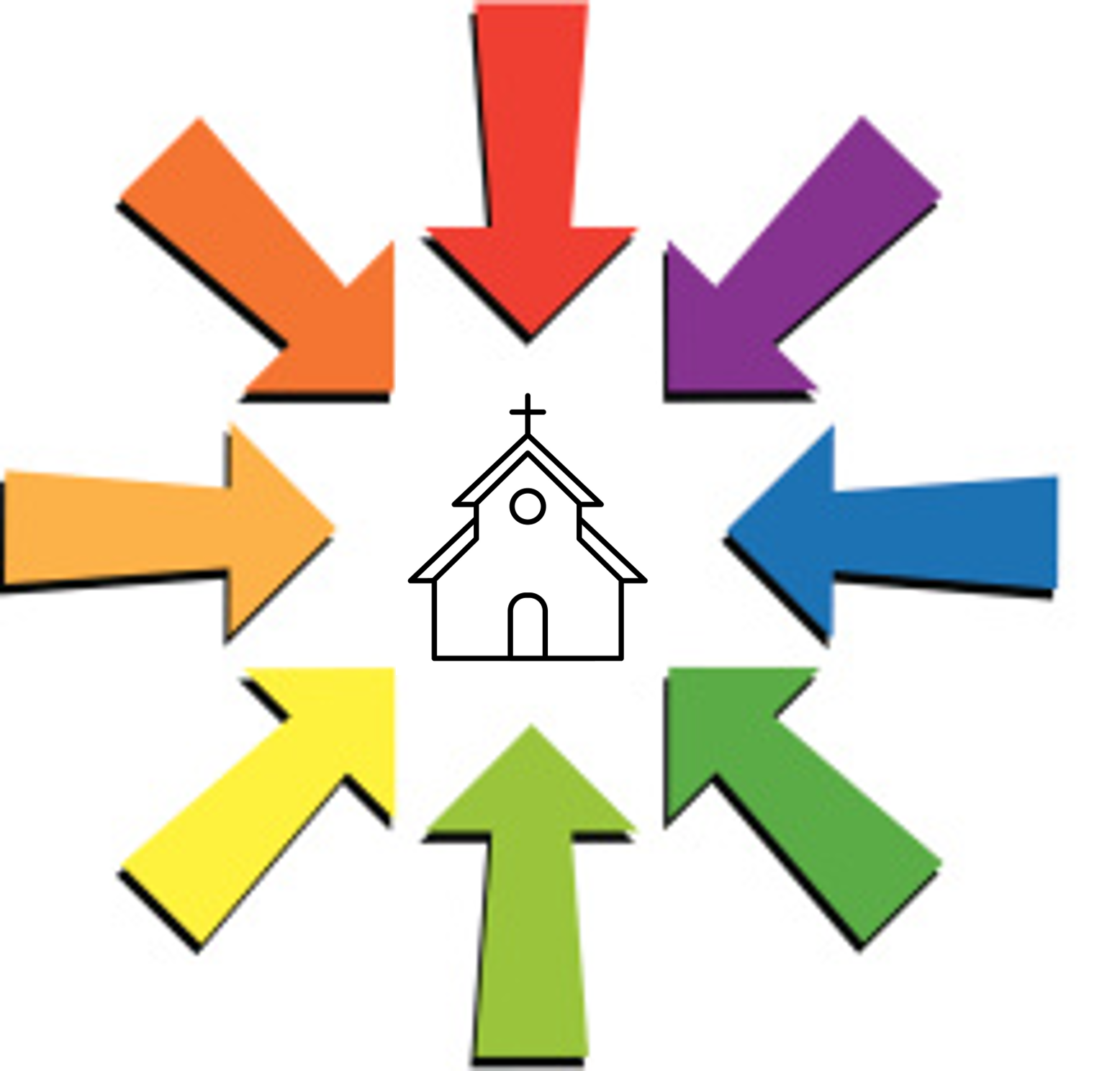
We can then think that our main job as Christians is to simply draw as many people into this club as possible. We put the institution at the centre and the energy is centripetal: drawing people into an institution.
Consequences
This kind of thinking about church has many negative consequences.
It sidelines where most of us spend most of our time – at work or in our local communities.
It can produce a faith which is ill-equipped to deal with real life. So ‘spiritually minded that its of no earthly use’.
It can promotes a false sacred-secular divide: as if God only cares about what goes on at church or within realms considered ‘religious’.
And perhaps worst of all, church becomes boring because it is chiefly about what is done in a building, once a week, rather than helping people live out an adventurous faith in the world.
God’s love for the world
Its an mindset illustrated by this quote:
“I teach Sunday School for 45 minutes a week and I get hauled down to the front of church for everyone to pray for me. I teach at an actual school for 45 hours a week and no one ever prays for me.”
We must resist this kind of thinking. God values the whole of life. It was because He so loved the world that he sent his son. In the Lord’s Prayer we pray ‘your kingdom come on earth as in heaven’.
I love Streatham Baptist Church but I love Streatham more. And our church is at its best when it is a genuine blessing our community: the outreach, the welcome to new people, fun days at Easter, The Vine, Friendly Club and Pre-School.
Equipped
The role of church is not to escape from the world but to equip us to live out our faith in Christ in the world. And this means in our communities and workplaces.

Rather than a religious club of liked-minded people, church is a place to be fed and equipped for mission. So rather than having the institution at the centre, its the message, the cross-shaped gospel of Jesus, which should be at the centre.
Jesus tells us to go out into the world and ‘make disciples of all nations’. So rather than centripetal and inward-focused, the movement, the energy should be centrifugal – spreading outwards. This is the difference between prosleytism and evangelism.
‘Whatever you do’
Church is a place to be resourced, taught, encouraged, filled, taught, exhorted to put faith to work. This dynamic is captured in Colossians 3:16-17:
“Let the message of Christ dwell among you richly as you teach and admonish one another with all wisdom through psalms, hymns, and songs from the Spirit, singing to God with gratitude in your hearts. And whatever you do, whether in word or deed, do it all in the name of the Lord Jesus, giving thanks to God the Father through him.”
The point of teaching, psalms, hymns and songs is so the message of Christ dwells among us richly. And this equips us so that whatever we do – at work, at home, anywhere – is done in the name of Jesus.
We are all called to be missionaries in workplaces and communities that desperately need the good news of Christ. Let’s remember, its when we leave church that we enter a place of worship.
This blog is based on a talk given at Streatham Baptist Church on 13/10/24. This can be seen on Youtube starting at 3:45.
Discover more from Grace + Truth
Subscribe to get the latest posts sent to your email.

 Grace + Truth
Thanks Jon for an accurate portrait of ‘Church’. My own Baptism & Confirmation is in the Anglican, but I have switched to the ‘indigenous’ (Latin ‘self-generating’), ‘Kaianere’kowa (Haudenosaunee-Iroquois = ‘Great-Good-way-of-kindness’ aka ‘Great-Law-of-Peace’ aka ‘Constitution’), which I believe is more in keeping with Jesus’ example of living loving ‘community’ (Latin ‘com’ = ‘together’ + ‘munus’ = ‘gift-or-service’) without the expensive & exploitive trappings. I understand Churches, Synagogues, Mosques etc are expensive colonial Oligarch funded ‘abstractions’ meant to be controlled by Oligarch fake ‘money’ (Greek ‘mnemosis’ = ‘memory’) ‘gifts’. Beware of big-boys bearing abstract ‘gifts’, icons, images, institutions, idols etc., because our primary Samaritan loving & living task are more about empowering each person in livelihood. https://sites.google.com/site/indigenecommunity/c-relational-economy/6-solidarity
All humanity’s indigenous ancestors cultivated distributed, decentralized ‘Religion’ (Latin ‘religio’ = ‘to-relate’ meaning not-to-indoctrinate or dominate) in the ~100 (50-150) person Multihome-Dwelling-Complex.
STRENGTHENING FAMILY & ‘COMMUNITY’. Individual-isolation in such as sprawl highway-dependent car-driven suburbs, leaves us entirely dependent & vulnerable upon the state & its TOP-DOWN INSTITUTIONS. Divided most people end up in impersonal Old Folk Homes & Hospitals for their end of life. Typically a living unit for about 10 people will see 5 shift staff plus 3 specialized staff per day = 2922 Changes of the Guard per year. I worked as a Specialized Educator over many decades to understand the cruelty of this segregation from family & community.
PUTTING HUMAN RELATIONSHIP, EXTENDED-FAMILY & ‘Economy’ (Greek ‘oikos’ = ‘home’ + ‘namein’ = ‘care-&-nurture’) back into the centre of our individual planning for a truly resilient sustainable future. Worldwide & on Turtle-Island (North America) all humanity’s ‘indigenous’ ancestors, lived strategically in intimate, intergenerational, female-male, interdisciplinary, critical-mass, economies of scale in the ~100 (50-150) person Multihome-Dwelling-Complex (eg. Longhouse-apartment, Pueblo-townhouse & Kanata-village) for many 10s of 1000s of years on every Continent, in every nation.
UNITED WE STAND: TODAY 70% of people live in multihomes with an average of 32 dwelling-units = ~100 people. Why has this most effective resource efficient relational Complex, been so resilient? Across Tsi Tiohtiake (Montreal Island) are 14,000 Multihomes (eg. Apartment, Townhouse & Village-clusters), living the most energy & resource effective lifestyles, with the strongest extended-family unit interactions, exchanges & meaningful relationships as the core of real ‘community’ (Latin ‘com’ = ‘together’ + ‘munus’ = ‘gift-or-service). Across Turtle-Island (North-America) are some 3 million Multihomes with the same average size today. We make our ‘religion’ as our everyday act of living, exemplifying love & caring in our everyday lives, where each of us is known & supported. When the stranger or refugee comes, we are more kind & capable as the united people Multihomes to welcome & economically include. As well as Multihomes, we also protect our community from possible abuse as well as have the expertise among us to firmly guide & direct, those who may have gone astray, back onto the path of love & participation in the whole. Institutions (of which I’ve been a part) which spring from Churches do not have this complementary specialized group capacity.
20% of Multihome-dwellers are extended-families living intentionally in proximity for social & economic collaboration. Multihome-extended-family contribute trillions of $ of the most individually appropriate goods, services, sharing & caring/year of health-care, food, shelter, clothing, warmth & health as Turtle-Island, N-America’s largest essential Economic sector, albeit unrecognized by government, education & institutions. https://sites.google.com/site/indigenecommunity/c-relational-economy/1-extending-our-welcome-participatory-multihome-cohousing
DO-WE-KNOW-WHO-WE-ARE-? (Some tools for making community real.) http://sites.google.com/site/indigenecommunity/d-participatory-structure/9-do-we-know-who-we-are web-based Community-Circular-Economy software:
A) CATALOGUE intake form for featuring individual & business Talents, Goods, Services & Dreams, where the seller choses her or his market & rates. https://sites.google.com/site/indigenecommunity/a-home/7-membership
B) MAP local proximal collaborative relations for complementary economic concertation. Baseline mapping of 105 Mohawk, Wendat & Algonquian Placenames in the Tiohtiake (greater Montreal archipelago) region https://sites.google.com/site/indigenecommunity/a-home/5-tiohtiake-mohawk-placenames
C) ACCOUNT for collective contributions, buying, selling & co-investment. https://sites.google.com/site/indigenecommunity/c-relational-economy
D) COMMUNICATE such as formally through COUNCIL PROCESS for creating Constructive Agreements & for Conflict Resolution. https://sites.google.com/site/indigenecommunity/d-participatory-structure/1-both-sides-now-equal-time-recorded-dialogues Local Multihomes each have Domestic Economies in the Millions of Dollars per year. Multihomes & their neighbourhoods are great launching pads for starting thriving business as most successful families & immigrants know. Circular Economy within these ancient traditional friendships, at price & salary rates chosen by the individual seller, combined with ‘Participatory’ (L. ‘part’ = ‘share’) capital ownership, make us strong communities again. When we are all strong economically from the bottom-up, Oligarchy has no one to parasite. https://sites.google.com/site/indigenecommunity/c-relational-economy/2-participatory-accounting
LikeLike
Jon, I remember listening to Paul Williams speaking at LICC a few years ago about how the gifts of the spirit were meant to be practised (rehearsed) in the church so they could be practised (used to bless) in the work and social lives we lived beyond. It seemed (still seems) a slightly left-field interpretation of 1 Cor 12/Rom 12, but it was the foundation of how I used the prophetic, prayer for healing m, and spiritual insight in my school, and has real power (as well as clear attestation in how the apostles used the spiritual gifts in Acts).
LikeLike
thanks Huw – that’s a helpful insight thanks. I think the ‘de-churchification’ of these kinds of gifts is really important. How can they be used in the world? There is a lot of talk about ‘re-enchantment’ at the moment and embracing the mystery of life – and following Jesus offers so much that could be used to reflect more deeply on what is going on in our work and social lives.
LikeLiked by 1 person
When I wrote my Grove book (Ed36, 2018), I tried to incorporate some ways in which we used the gifts of the spirit, both as stories of things that had happened, and as possibilities and ‘what ifs?’ within our school, exploiting its deliberate Christian foundation whilst we were also a state-funded primary. I think that (following one of your bugbears) it became a way of keeping a public facing Christian institution deliberately and actively Christian, in the midst of public service.
LikeLike
Yes and amen to both the blog post and Huw’s comment!
LikeLiked by 1 person
thanks Mark!
LikeLike
Nice article, I read it all the way through with great interest. I just discovered this blog and I like it. I will definitely read more articles. Regards!
LikeLike
This point has been made often over the past few decades, but sadly most churches remain unchanged. The focus is still on keeping the operation running with the centre being the Sunday service(s).
There is an old management saying, what get’s measured gets done. Most churches only measure one thing; attendance at Sunday services. Its how most church leaders are judged by their people and their peers.
I’m guessing most church leaders with formal training get that church isn’t just a club that exists to recruit new members, but it doesn’t seem to take long before they get wrapped up in the treadmill of weekly services.
My solution? Ban church leaders from preaching at Sunday services.
LikeLike
I’ve always loved that passage from Colossians and see it, very much, as being worked out in day to day life of the body, between us as children of the Father and not just, or even, as something done to us in a building on Sunday. Everyday help if you like.
LikeLike
Hi Jon
On the Youtube video, it finishes, not starts, at 25:20 It starts at around 6 minutes in.
Noel
LikeLike
thanks Noel – I realised I got this wrong so amended it – thanks for the spot!
LikeLike