
The text of a sermon I gave at the Labour Party Conference Church Service on 22/9/24. The bible readings were Isaiah 65: 17-25 & John 10:7-18
In the field of homelessness, where I have worked for 30 years, you cannot avoid the twin issues of politics and faith.
Rough sleeping is a sensitive political issue because it’s such a public display of social exclusion and poverty. My first job in the early 1990s, was in a hostel funded by the first Rough Sleeper’s Initiative started by Margaret Thatcher.
In the late 1990s, I was manager of a shelter for homeless young people funded by the Social Exclusion Unit set up by Tony Blair. I will never forget when the late Mo Mowlam came to open the shelter and she was heckled by a few residents. Her advisers got nervous but Mo took them on. I can’t share exactly the words used in a church – but she gave as good as she got! She then stayed longer than planned to talk with the residents and the whole visit showed a politician who really cared.
And in recent years I was seconded to the Civil Service as an Adviser as part of the last government’s attempts to reduce rough sleeping. I could name the Prime Ministers I worked under but it would too long! There were 4 different ones in 4 years I was there – and 7 Homelessness Ministers. But despite that, it was a great experience to be part of the team who worked during the pandemic on the Everyone In scheme to bring rough sleepers in. There was much heroic work by local authorities, charities and faith groups.
But also, issues of faith are closely connected too. The majority of homelessness charities were established by churches or Christian leaders. Just consider the 4 charities I have worked for in the last 30 years:
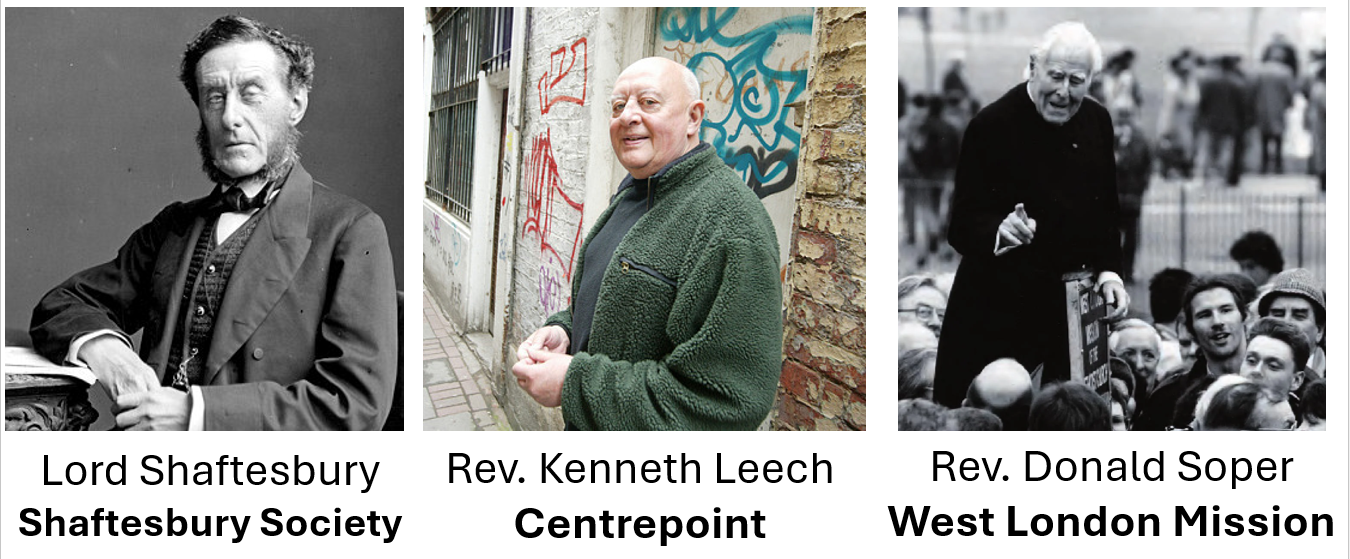
- The Shaftesbury Society – named after Lord Shaftesbury, the prominent Victorian evangelical social reformer.
- Centrepoint started by Rev Kenneth Leech when he opened up his church’s crypt as a night shelter for young rough sleepers in Soho.
- And the West London Mission, part of the Methodist Church which Rev. Donald Soper, later Lord Soper, led for decades.
For each of these very different people, it was their faith that inspired their practical social action to address poverty and homelessness. But each was also deeply political too – Shaftesbury as a Tory peer, Donald Soper as an outspoken activist and Labour peer, and Ken Leech as an author and activist.
Hope into Action
And faith is not just something historic. I now work for Hope into Action, a charity started by Ed Walker 14 years ago after he met a man who was homeless in his local park who had just left prison. This man had nowhere to go because no one to go to.
Ed used his own money from an inheritance to purchase a house for people who are homeless in Peterborough – and from this seed of faith our work was born. 14 years later, we now have a network of 118 homes and last year we housed 486 people.
And we haven’t just got a ministry to people affected by poverty but also to those with wealth: we have had over £29m invested in homes for homeless people.
Faith is right at the heart of what we do. We pray every day together as a team and each of our houses is partnered with a church. We provide tenants with professional support and our partner churches provide vital friendship and community.
Rise of social action
The last 20 years in response to rising poverty. The policies of austerity – boom in Christian initiatives such as night shelters, food banks, street pastors, warm hubs.
As CAP and Housing Justice would confirm, when it comes to poverty and homelessness, things are bleak – with rising rough sleeping and more people in temporary accommodation than ever before.
These realities mean we need to ask hard questions about the future direction of Christian social action – and drawing on today’s Bible readings, I want to suggest three key priorities: justice, empowerment and faith.
1.Justice
Social action has grown hugely – but what does this say about the underlying social and economic systems which create such need in the first place?
The church must avoid just becoming the handmaid of the state, running around filling in gaps caused by government neglect. We must not be seduced by the lure of feeling useful.
The underlying commitment must be to a more just society. The reading we heard from Isaiah 65 is an inspiring picture of a renewed creation of justice:
- A place of delight and joy where ‘the sound of weeping and of crying will be heard no more.’
- A place of long and healthy lives ‘Never again will there be in it an infant who lives but a few days, or an old man who does not live out his years’
- A place of housing justice ‘They will build houses and dwell in them’
- Of food security: ‘they will plant vineyards and eat their fruit’
- Of dignified work: ‘People will enjoy the work of their hands.They will not labour in vain’
- Of healthy family life: ‘nor will they bear children doomed to misfortune’
It might be 3000 years old but it’s a vision that any election manifesto would love to inspire. This is the integrated Christian hope – what Jesus describes as the ‘renewal of all things’ – heaven is NOT some disembodied place where we float around on clouds: it is a renewed creation, full of relational justice.
As Desmond Tutu put it:
‘Christians should not just be pulling people out the river. We should be going upstream and seeing who is pushing them in.’
2. Empowerment
The growth of social action provokes other questions – do initiatives and projects actually help? Or do they create other problems or even make things worse?
The homelessness sector has long discussed these issues. For example, how much does it help to give out food on the streets? Or how the sky-high rents in supported housing deny people the opportunity to work?
It’s a sensitive area that causes heated debates – but we need to talk about it because helping people in complex situations is rarely straight-forward and good intentions are not enough.
The important principle is empowerment – does our work give power to people to help make the most of their skills and strengths? Does it build mutuality – a two-way exchange or are we turning people into passive recipients?
Consider some of the lines from Isaiah’s vision:
- ‘They will build houses’
- ‘they will plant vineyards’
- ‘People will enjoy the work of their hands.They will not labor in vain’
Life to the full is far more than ensuring resources are well distributed – it involves work which is fulfilling and properly-rewarded and where relationships are central.
This is why addressing homelessness is not just about giving accommodation – often that’s the easy bit – the harder task is often establishing trusting relationships and restoring people’s identities.
It is popular to use the phrase ‘speaking truth to power’ but actually one of the key tasks is also how we speak truth to those with little power – truth which does not crush or condemn but also doesn’t collude. Truth combined with grace which helps them find freedom to gain power over the challenges they face.
Hope into Action’s frontline staff are called Empowerment Workers and one of our tenants, who had suffered terrible domestic violence said this to me:
‘My Empowerment Worker didn’t just give me a ladder to help me get out of the situation, she showed me how to build my own staircase.’
3. Faith
I was speaking with someone at a Christian conference about talking openly about Jesus and ‘always mention the J-word’. And someone joined us and was nodding along and then said ‘Yeah the J-word absolutely, justice is so important.’
Justice is vital – but Christian activism should never neglect the central focus of following Jesus.
In the passage, Jesus describes himself with two sheep related metaphors. Firstly, he says: “I am the gate, whoever enters through me will be saved…”
Secondly, he is the ‘good shepherd’ that guides and protects his flock: there is one flock and one shepherd. And the way he leads is through sacrifice – choosing to lay down his life for the sheep.
Jesus is the gate and guide to the kingdom that Isaiah spoke of: “I have come that they may have life, and have it to the full.” It is in following him and his example that we experience life in all its fulness.
And in social action the role of faith is easily neglected – faith gets skimmed out until all trace is gone the homeless sector is full of organisations that used to be Christian. But I believe the times call for a more ‘full-fat’ approach.
Last year, over 60% of our tenants wanted to be prayed for – and 16 were baptised or took a formal step of faith. As one Hope into Action tenant said recently at her baptism:
“I am a recovering alcoholic, 509 days sober today. The Lord did not give up on me. He saw fit to help me rebuild my life. He gave me a safe home to live in, support from Hope into Action and the generosity of Portsmouth Christian Fellowship. I owe my life to Jesus Christ and I ask that you all bear witness to my declaration of faith in him.”
Conclusion
As I conclude, I want to acknowledge someone whose life’s work connected so powerfully to each of these themes: Frank Field, the former long-term MP for Birkenhead who died earlier this year.
Frank was a continual inspiration to me for his passion for justice and his willingness to say hard things about what truly empowers people affected by poverty. And he rooted everything in his strong Christian faith. The title of his memoir sums this up: Politics, Poverty and Belief. In it he wrote:
‘It is from the Bible that I take the revolutionary basis of my politics: teachings about the kingdom of God…it is a story that makes more sense to me in understanding the world, and our place in it, than any other set of beliefs’
Let’s not forget that Jesus and his kingdom are revolutionary – they turn the values of this world on their head. Life to the full isn’t found in wealth, fame or power. Greatness is found in service. The defining symbol of the most influential person in history is not a throne or a statue – but a cross. His ‘laying down his life’ is the template for us all.
This is the way to Isaiah’s vision of justice – the clue to the kingdom of God – the path to find life in all its fulness.
The service can be watched here on YouTube – my talk starts at 50 mins on the recording
Discover more from Grace + Truth
Subscribe to get the latest posts sent to your email.


Thanks Jon, just right
LikeLike
thanks Guy
LikeLike
Watched it on Sunday John. Great message. Brilliant speaker as always
LikeLike
thanks Vanessa – that’s very kind
LikeLike