Revolutionary France, 1790s: a mob is rampaging through the streets of Paris, smashing up shops, looting and assaulting people.
Trailing fifty yards behind the chaos is an older man struggling to keep up. As he stops and leans on a wall to take a breath, a man asks him ‘My friend, why do you run after the mob? Why are you trying to keep up with them?’
The older man replies ‘I have to…I’m their leader.’
Disempowered leaders
I was reminded of this story when listening to the Radio 4 programme The priest and the pay-off.
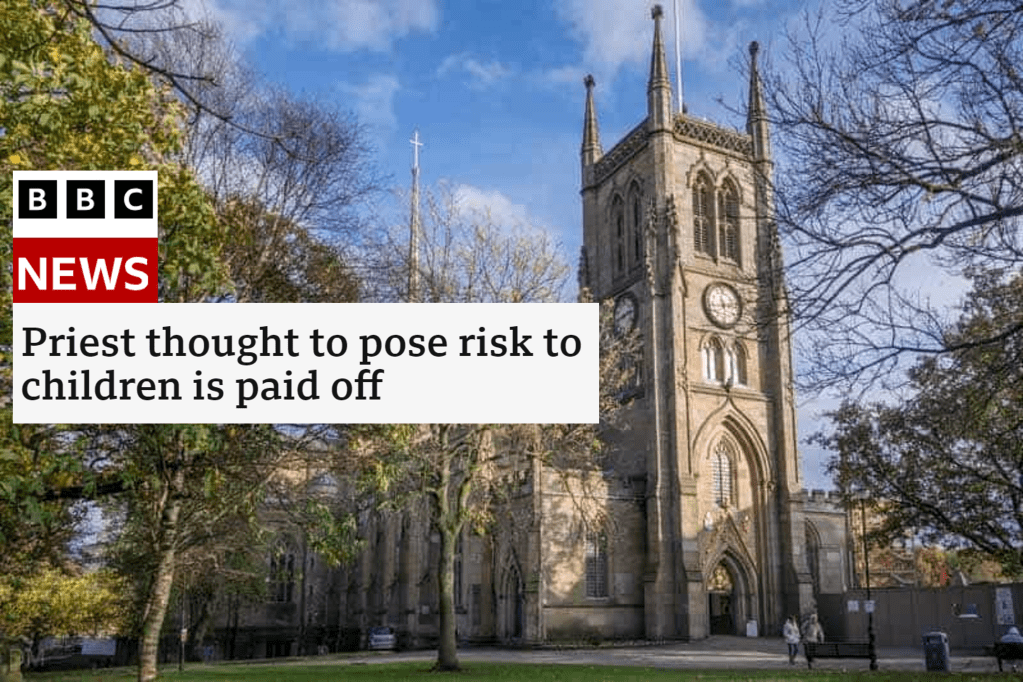
It was because of how disempowered and ineffective the Church of England bishops interviewed sounded in trying to defend the decision to give a £240,000 pay-off to Canon Andrew Hindley of Blackburn cathedral to leave his job. This was despite 25 years of safeguarding concerns being raised about the canon’s behaviour and that he was considered a significant risk to vulnerable people.
Following the pay-off, Rowena Pailing, the cathedral’s vice-dean and head of safeguarding, quit her role, saying of the Church of England:
“I couldn’t work for an organisation which put its own reputation and the protection of alleged abusers above the protection and care and listening to victims and survivors.”
A new low
It’s a sentiment that we have got numb to hearing from numerous survivors of abuse and their advocates. But this sorry episode surely marks a new low for the C of E’s handling of safeguarding. That someone with such a terrible track record is able to walk away with such a massive pay-off beggars belief.
A phrase like ‘not fit for purpose’ has become over-used but it has never been more apt. The fact that the C of E considered closing the cathedral as an option instead of properly dealing with Hindley’s behaviour is clearest example of an institution no longer able to manage itself.
Worst possible witness
Situations like this are the worst possible witness to Christianity. What is the point of the C of E investing in initiatives like The Centre for Cultural Witness when it fails so palpably in situations like this? All the nice words and clever theology about justice, reconciliation and truth ring utterly hollow.
I have written about safeguarding in the C of E mainly because of the incompetent and vindictive way that my brother, the Rev’d Stephen Kuhrt, was treated by Southwark diocese in response to him whistleblowing about safeguarding failings.
After an entirely unjustified suspension of 5 months he was eventually reinstated, but the continuing actions of the diocese give no cause for confidence. When efforts to bring about his constructive dismissal failed, he too was offered a pay-off to leave quietly. Strong local support from his congregation helped him to reject such offers and continue in his role.
Governance void
The independence of the 42 dioceses (all separate charities) which make up the C of E means that no-one is really in charge and there is a huge void in the central governance. Organisationally, it is like a giant doughnut.
This means that all the strategies, reports, training and ‘sincere apologies’ from archbishops count for little when there is no proper governance to actually implement change. Rather than clarity and accountability, there is disempowerment and fudge.
Lack of courage
But listening to the Radio 4 programme made something clearer to me. That beneath the unwillingness to really tackle the roots of this problem is a basic lack of courage.
The C of E’s failure to dismiss the canon was not because of a lack of evidence but due to a lack of moral courage to do the right thing. They saw the risk of being sued by him for wrongful dismissal and buckled and bottled it. No one provided a clear moral lead and so a pragmatic instinct to safeguard the institution won out.
Pressure to settle
I know what it is like to have to go to court to defend yourself. About 10 years ago, when leading a Christian homelessness charity, I was taken to a tribunal to face allegations which threatened to tarnish my reputation and career.
The pressure to ‘settle’ the claims out of court from HR advisers, employment lawyers and insurers was significant. I had to stand firm against this pressure because I was determined to fight the allegations rather than avoid them.
Truth upheld
It was a tough few months and especially a challenging four days in court. But ultimately the allegations were found to be false and truth was upheld. And I cannot emphasise enough how important fighting these claims was. If I had settled the claim and agreed to pay someone off for making spurious claims then something inside me would have died. As Martin Luther King said:
“Our lives begin to end the day we become silent about things that matter.”
Truth matters. When we duck challenges and avoid standing up against deceit and injustice then we begin to spiritually die. And this is true both on an individual and institutional level: decisions like those made in Blackburn mark a route to decay and death.
‘The biggest cause is fear’
Recently, I had to complete an online C of E Safeguarding course for a summer youth camp I help lead. On the course they pose this question:
‘Why do we struggle to respond well to safeguarding concerns?’
And the answer they give is:
‘The biggest cause is fear’
This was the key problem in the case of Canon Hindley. A personal and institutional lack of courage meant that fear of doing the right thing won the day. And this fearfulness has led to a succession of poor decisions which have now been exposed.
Gateway to all virtues
The significance of courage is that it is not just one of a number of virtues, but rather it is the gateway to all the others: As Maya Angelou said,
“Courage is the most important of all the virtues, because without courage you can’t practice any other virtue consistently.”
This is why Jesus so often tells his followers so often not to fear, not to be afraid and not to worry. Fear curves institutions and individuals in on themselves. It makes us protective about the status quo and value pragmatism over truth.
Forfeiting our souls
It takes courage to put our comfort and security at risk, but this is precisely what Christian are called to do. Jesus said in Mark 8.35-36 :
‘For whoever wants to save his life will lose it, but whoever loses his life for me and the gospel will save it. What good is it for a man to gain the whole world, yet forfeit his soul?’
In Blackburn, a big pay-off may have lined an individual’s pocket and a non-disclosure agreement may have tried to protect an institution’s reputation. But actually, both are signs of moral bankruptcy: the soul of the church sacrificed on the altar of expediency.
Listen to The priest and the pay-off on Radio 4
Discover more from Grace + Truth
Subscribe to get the latest posts sent to your email.

 Grace + Truth
thank you Jon, it was disturbing. It is a case which shows that the office holder rather than employee status of clergy means that we are largely unaccountable for anything other than the most egregious offences. Our authorities have no legal powers to dismiss and so clergy can remain in post, ineffective, poorly behaved to the detriment of parish ministry and a scandal to the world and the frustration of the many other committed and hardworking clergy.
LikeLike
Thanks Guy – but where is the commitment of the leaders to change these arcane arrangements? How can safeguarding mean anything when people are ‘largely unaccountable’? Why has not tackling this been the number 1 priority for bishops and archbishops?
LikeLiked by 1 person
Good article. Safeguarding is a mess in the C of E. It costs a lot of money and time and work. We have to do risk assessments for everything, which would be ok, if the vulnerable were really being protected, but clearly these sort of cases prove they are not. I know of a church near me where safeguarding has been contacted on more than one occasion because of disagreements between clergy and parishioners. Nobody was at any risk of any form of abuse, but just because the clergy member upset them, they go crying out to the safeguarding officer, who has to investigate, even though none of these are really safeguarding issues. It seems that people are confused, despite all the training courses. There was a case in the catholic church recently of a priest abusing young people on trips, and the bishop on learning about it,, immediately removed him from office and informed the police. There was a lot of praise that finally the catholic church had learnt from its past errors, I don’t know if that is true, or whether it was just one Bishop who was prepared to stand up for what is right. The CofE need many of such Bishops
LikeLike
‘an organisation which put its own reputation and the protection of alleged abusers above the protection and care and listening to victims and survivors.‘
This is exactly why Philip North’s suggestions for the future are so utterly inadequate.
He offers zero acceptance of responsibility, and no personal repentance, as all the Church’s leadership should do for the safeguarding failures of the last 40+ years.
When, and only when, the leadership take such individual responsibility and offer (that means demonstrate by their actions, not repeat the tired & reabusive words of the past decades) personal repentance, will survivors listen to anything else they have to say.
LikeLike
Brings it all back. He is still the vicar in the same parish, doing the same role. He still tells people it is God’s plans and will. No apology from the Diocese and no compensation. The Archdeacon was useless, and they hid behind the cloak of ‘confidentiality’. The damage in the wake of his mismanagement, Spiritual abuse, and lack of even basic employment skills; has left myself and my family with deep emotional wounds and myself with constant mental health struggles. He’s still the vicar.
LikeLike
Churches Together in Lancashire is working with No Whispers CIC to offer an interdenominational approach to safeguarding – in the hope that there really is willingness to “learn from this”. We must do everything we can to address these appalling situations and the best way is to work together with courage, humility and honesty.
I do recommend the work of No Whispers CIC https://no-whispers.co.uk/ and LoudFence https://loudfence.com/ which the Catholic Church in particular has embraced.
LikeLike
thanks for sharing Anton and these links are very useful.
LikeLike