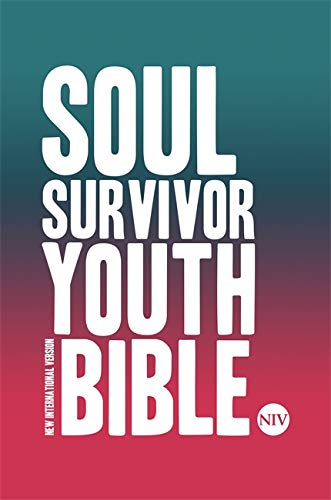
We have a Bible my daughter was kindly given by her former youth group designed and marketed for young people: The Soul Survivor Youth Bible. I bet thousands of other young people have a copy too.
But since the closure of the Soul Survivor festival and the scandals caused by Mike Pilavachi’s abusive and manipulative behaviour, the branding of this Bible provokes questions.
Is it appropriate to still use it? Is it a good idea for publishers to brand Bibles in such a way? What can be learnt from such marketing?
Endorsements
Bible publishers have regularly produced bibles aimed at specific groups: children, students, men, women, those into sports. I have two different versions focused specifically on social justice.
And Christian leaders are often used to give endorsements. Steve Chalke’s photo used to be on the back of all the Youth Bibles we had at our church. And at a retreat centre I went to recently had brand new Bibles all featuring a prominent quote from Philip Yancey on the cover.
I admire both these Christians but I have doubts about the wisdom of using their names and photos as promotional tools. The Bible’s message may be holy but Christians tend to be less dependable.
Pedestals
One of the vulnerabilities within Christian culture is our tendency to put leaders on pedestals, elevate them into ‘spiritual giants’ and allow them to become an unhealthy focus of our aspirations. The culture of publishing, events and platforms means that the lure of profile and ‘fame’ can be a bigger temptation in the Christian world than in the secular context.
This tendency is dangerous – both for the leaders themselves and their followers. We need to undermine pedestal culture and expose its superficiality. If our faith is too dependent on a certain leader or institution then its built on sinking sand.
Christian leaders are just as vulnerable as others to being seduced by money, sex and power. We don’t need cynicism but an earthy realism of the common struggle we all face in following Jesus.
Stark reminder
And actually, this is why I have concluded that my Soul Survivor Bible is helpful: because it is a stark reminder of the vulnerabilities of Christian leadership. Its branding and introduction by Mike Pilavachi illustrate a theme which runs through the whole of scripture: human and institutional fallibility.
The stories within the Bible never airbrush out the serious wrongdoing of its heroes. Abraham, Lot, Jacob, Moses, David, Solomon and just about every major character are either flawed or do terrible things. And it’s not just bad individuals, the prophets continually rail against Israel’s collective idolatry and structural injustices.
No air-brush
Jesus’ disciples are slow to understand, bicker over status, are judgmental, fearful and all run away when their leader is arrested. Peter even denies knowing Jesus. And as many of Paul’s letters show, the early church communities are messy, fractious and vulnerable.
The Bible never air-brushes the wrong-doing of its key characters, of Israel or the early church. Those charged with carrying the message of God’s grace continually mess up.
Humans are all fallen and frail beings. Our faith needs to be in the message and not the messengers.
Ambivilant reality
A black and white world is attractive but its not reality. We need to resist the social media algorithms which encourage us to divide the world into goodies and baddies. When we think like this we deceive ourselves and the truth is not in us.
And this ambivalent reality is shown in the sheer amount of good fruit and positive change produced by the Soul Survivor festivals.
Encounter with God
A good example is the faith journey of Elizabeth Oldfield, the influential host of The Sacred podcast and author of the brilliant book Fully Alive. She was not raised as a church-goer but writes about how she first encountered God at a youth festival in the 1990s:
‘I listened to a large man in a Hawaiian shirt give a talk about the relentless pursuit of God’s love. I could feel something aching in my chest, some kind of longing, some kind of lack. Around me people were singing and praying in unrecognizable languages, and the joy that had seemed cringey and earnest was now deeply attractive. So I prayed: ‘God if you are there, show me.’
This encounter at Soul Survivor, listening to someone now considered disgraced, changed the direction of her life. And I know that the same is true for countless other people.
Divine and dusty
None of this justifies terrible behaviour or reduces the harm done.
But it does highlight the way God works through broken humans. We are all chipped and cracked and fractured. The church is forever a complex mix of the divine and the dusty.
This is reality. And acknowledging this truth helps our souls to survive.
Discover more from Grace + Truth
Subscribe to get the latest posts sent to your email.

 Grace + Truth
Thank you for wise words.
LikeLike
Thanks!
LikeLike
if Shakespeare himself wrote a blog then it would be in a similar vein to this piece. Jon, this is a magisterial article and the kind of prose that I would expect from the Bard himself. 9.9/10
LikeLike
Thanks Tim – always appreciate the numerical scoring!
LikeLike
Thanks so much for this Jon- exceptionally helpful as always – especially the comment on the celebrity status.
LikeLike
Thanks for reading and commenting Ruth – you are very encouraging!
LikeLike
Great article Jon. One of the other dangers (IMHO) of these ‘branded’ bibles are some of the extras that are added in – sometimes useful historical facts and background info, but often interpretations of the text that are, at best, preachy and, at worse, bad theology (or at least of a certain vein of theology that may not allow for the non-black and white that you mention).
I am increasingly grey (in theology as well as hair) and look back cringeingly at some of the bibles I have bought over the years – particularly when an impressionable youth. I still have some signed copies from CYFA camps!!
As a real life example, a parent of a young person at our church youth group recently asked me if I could recommend a good youth bible for their child (who had asked for one out of the blue!). The honest answer was that after a lot of research I struggled as there was so much ‘extra’ content in so many youth bibles that I wasn’t sure I could hand-on-grey-heart recommend!
LikeLike
Thanks Nick. To be fair I think a lot of the content in the Soul Survivor Bible is pretty good stuff – quite a lot about justice and explaining the big picture of scripture etc…but obviously it will not be to everyone’s taste. I think a Good News Bible is a good option- I still think those line drawings are genius! Thanks for reading and commenting.
LikeLike
I understand fully what you have written, Jon. Always spot on. My confession is that I still have books written by Bill Hybels on my bookshelf – it is a matter of separating the writer from the message. After all, there are plenty of Biblical authors who messed up.
LikeLike
Amen. That’s exactly the point I am making!
LikeLike
Couldn’t agree more. https://godschool.wordpress.com/2016/02/07/why-do-we-need-heroes/
LikeLike
Thanks for sharing this Gill. I thought these 2 paras were particularly relevant:
“Maybe the fault is as much with us as with them. Our desire for heroes and our insistence that they are ‘ideal’ people means that we put expectations on to other human beings that they aren’t able to fulfil. These expectations spread out to other figures in the community: doctors must never be wrong, or they are rubbish. Football team managers must always cause their team to win, or they’re sacked. It’s all or nothing.”
and
“Is it the ‘hero culture’ that allowed paedophiles like Jimmy Savile and Rolf Harris to do their loathsome work, thinking that nobody would expose them? And isn’t it the ‘hero culture’, the putting of priests on pedestals, that has allowed abuse in the church to go unchecked? People are afraid to unmask heroes, and people do not like discovering that they have been wrong about them. We are foolish enough to want to cling to our illusions.”
LikeLike
Hi Jon! Cozza’s Canadian buddy, here.(met at 22 via Careforce and the Hillingdon Project…)
I started reading this post but my eyes are too dry to do it justice right now, so maybe later. But I just want to share a memory sparked by your comment about personalities’ names and faces included on Bibles, to endorse various translations, and repackaging with extra-Biblical notes, helps, reading plans, etc.
the year before zi joined Careforce, I attended Capernwray Bible School in Lancashire, outside a town called Carnforth. In preparation for my studies there, my Mom paid for a study Bible of my choosing. In order to select one, I perused a few for the choice of translation, readable font/font size, inclusion of definitions, index/concordance pages, maps, footnotes, timelines, room to joy notations, etc. Once I had chosen one, I held off using it until I got to ‘the castle’ (nickname for the big old rural Manor House that the founders had converted into a school of the Bible fir people from around the globe. I wanted to start using my new study Bible when I started my year at Capernwray. I think it may have therefore been in England, tbT I realized my new Bible had something I’d not seen in a Bible before: DEDICATION PAGE, commemorating some guy (maybe one of the team of translators or academics who had helped develop that particular Bible and it was prominently featured in the first pages; I think in front of the table of contents. Something rose up in me and I carefully tore out that page and muttered something lijke “Uh-uh! That’s got no place in my Bible. I didn’t know back then that I had ADHD. I just knew I didn’t want to have my focus derailed by my copy of the scriptures telling me every time I opened it, that it was written in tribute to some (probably) dead old white human. 😐
looking forward to reading the rest of this. Be well!
LikeLike