
Why is George Orwell my favourite author? Because he had the bravery and conviction to channel his creative genius into genuinely independent thinking.
Today, more than ever, we need thinking which challenges the cultural silos and echo chambers we become stuck in.
Orwell was a socialist, firmly on the political left-wing and was fiercely critical of inequality and the poverty of his age. But he was no ideological prisoner to this tribe and was free and unflinching in his critique of the excesses and laziness of left-wing politics.
Incorrect assumptions
Orwell’s two most famous books, Animal Farm and Nineteen Eighty-Four were both rejected by left-wing publishers who, though they had printed his work before, were concerned by the book’s obvious criticisms of Russian communism. The global impact of the books led many commentators, especially in the US, to incorrectly assume Orwell was a right-wing reactionary.
Towards the end of his life, Orwell released this statement in June 1949 after Nineteen Eighty-Four became a bestseller in America:
“My recent novel is not intended as an attack on socialism or on the British Labour Party (of which I am a supporter) but as show-up of the perversions to which a centralized economy is liable and which have already been partly realised in communism and fascism.”
Influence of war
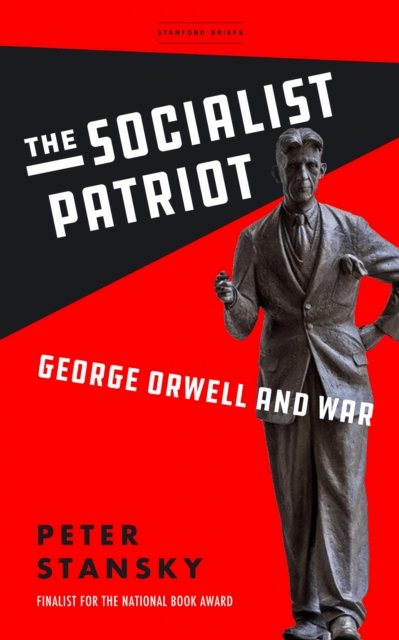
Peter Stansky’s excellent book The Socialist Patriot: George Orwell and War explores how the context of war forged Orwell’s unusual thinking.
He analyses how 4 wars influenced him: the First World War that he observed as a school child, the Spanish Civil War in which he fought and was injured, the Second World War in which he served in the Home Guard and worked for the BBC, and finally, the Cold War where his writing achieved global influence.
Unusual tension
The book’s title illustrate the tensions that Orwell held together in an unusual way. Most people would not associate socialism and patriotism. But Orwell did: he wanted to see a revolutionary reorganisation of wealth and power but he argued for this change from a deeply patriotic basis.
His wartime essay The Lion and the Unicorn is the fullest expression of this. He argued that socialism was vital to winning the Second World War and successfully rebuilding the country afterwards. He criticised the fashionable sneering about the value of nationhood that was common among the left-wing intelligentsia: Orwell believed in England, and its distinct values and was committed to fighting for it.
Another war
In addition to the 4 wars that Stansky refers to, I would argue there is a fifth war where Orwell’s writing and example are deeply relevant: the culture war that currently rages between conservative and liberal perspectives.
It’s a war shaped by its primary battle ground, the internet, but it is increasingly spilling out in real world conflict.
The current arguments about immigration are an example. Rather than discussion about policies that create fair and reasonable systems to manage immigration, the situation is oversimplified and exploited on all sides as a political football. And the polarisation online increasingly stokes actual conflict in real-life communities.
Warning
In all wars, the first casualty is truth. And today we are all combatants in the battle for truth.
The challenge of truth-telling is personal. It starts with us. In our workplaces, communities, schools, universities, whatsapp groups, conferences and churches, there is a urgent need for people who are willing to speak truthfully.
Inherent to truthfulness is acknowledging the tensions and complexity involved in social and political issues.
Simplistic polarisation thrives online because it’s a world of media and words rather than practical action in the mess of the real world. It wins superficial applause, ‘Likes’ and ‘Shares’ because this is how echo chambers work.
Far too many conferences on social issues are similar. They pretend to discuss issues but are full of people safely agreeing. If you are not grappling with genuine tensions you are doing little of any real worth.
Divine resources
In my prayer book this morning, I read this quote from John Bell:
‘Where in our contemporary devotions are there glimpses that God can be expected to surprise, contradict, upset or rile us in order that the kingdom may come?’
I believe we need to listen to the God who surprises, contradicts and riles us. We need stirring from complacency.
And this is why Christianity has a key role in fostering better public debate. Not simply because of ‘niceness’ or a desire for harmony, but because it offers the resources of grace: an external point of divine justice and moral truth which can influence a more humble, restrained and grace-filled conversation.
As the online culture wars show, self-righteousness deepens divisions. But a sincere faith, full of grace and truth, can help build the common good.
Buy The Socialist Patriot: George Orwell and War by Peter Stansky (2023, Stanford Briefs)
Discover more from Grace + Truth
Subscribe to get the latest posts sent to your email.

 Grace + Truth
Great, Jon. Thank-you. I was reading Parker Palmer’s most recent Substack yesterday where he covered similar ground but argued that in the US, at least, the weapon used to subvert the truth, especially on the right, is desecration: turning what is held and seen as sacred into something to be hurt (the rights of minorities, the democratic process, people of faith arguing for justice for immigrants, etc) and damaged with personal attacks. We on the left can be as bad or worse, but the right errs most clearly when as conservatives they fail to conserve anything of value. Orwell understood what it was to conserve the good, I think.
LikeLike
Thanks Huw. Yes, I think admitting and owning the fact that some things really need conserving and protecting is obviously true and vital and often the left is very weak at doing this. I would say the importance of family is a good example where in my experience there is a real reluctance of speak about family life because of a concern about sounding ‘conservative’. I often think of when Jesus said that a teacher instructed in the kingdom of God brings out of the storehouse ‘old treasures as well as new’ in Matthew 13:52. Thanks for reading and commenting.
LikeLike
Jon, Smashing piece as ever.
You say that ‘Most people would not associate socialism with nationalism’. Yes and no I would say.
You could argue that most people in the UK totally associate socialism with nationalism. In the sense that polling repeatedly tends to show the majority of British people do exactly that – in that the average voter is nationalistic and tends to lean left economically. Of course you don’t get that impression living in London, which is determinedly internationalistic, but the national polling tells a very different story.
What is true is that in recent times that majority of the British people has struggled to work out who to elect though, as no political party or politician has aligned/chimed with both elements of that majority view – nationalistic and left of centre economically. Confusion and tension has resulted.
Today we do have Morgan McSweeney – the PM’s Chief of Staff – and of course Baron Maurice Glasman and his cadre of Blue Labour acolytes, who do very much associate – indeed seek to fuse – socialism with nationalism. But you could likely easily fit that number into the Wetherspoons on Streatham High Road. And influential though they are in some respects they are by no means entirely ‘in charge’. The public doesn’t know who they are.
While of course there were back then determined internationalists too, this was not the case in Orwell’s time. While he was indeed a great and independent man and thinker, he was not an outlier. The post war Labour government for instance – that did so much to build the Britain we know today – was avowedly nationalistic. In particular Attlee, Bevin etc were deeply sceptical and suspicious of international initiatives such as the European Convention of Human Rights and the formation of the precursor to the European Union. Which they did not like at all, because they believed these supranational constructs would likely undermine, not support, their plans for a patriotic socialist state with control over its own destiny. It was Churchill who initially mainly championed the ECHR in the UK, and the political right that favoured entry into the European Union for market access and trade reasons.
Orwell’s views are illuminating and instructive. It is right to highlight them and the perspective that informed them and which they may provide to us today. But I think they were by no means unique. Perhaps that was because the wars of that time also influenced some other people similarly.
LikeLike
Hi Jonathan – thanks so much – really illuminating and helpful additional information and perspective. I guess Orwell’s fame in writing 2 of the most significant novels ever means he gets more airtime than others but your stuff on Attlee and Bevin really makes sense.
I really like Glasman and much of the Blue Labour emphasis but I agree that its profile is not high. I think the fact that ‘the average voter is nationalistic and tends to lean left economically’ is true and the failure since early Blair to have a politician who articulates this well and confidently is a tragedy of the last 20 years.
If you wanted to write anything further on the on-going immigration arguments and the growth of St George’s flags across communities then do be in touch.
Thanks for reading and commenting.
LikeLike