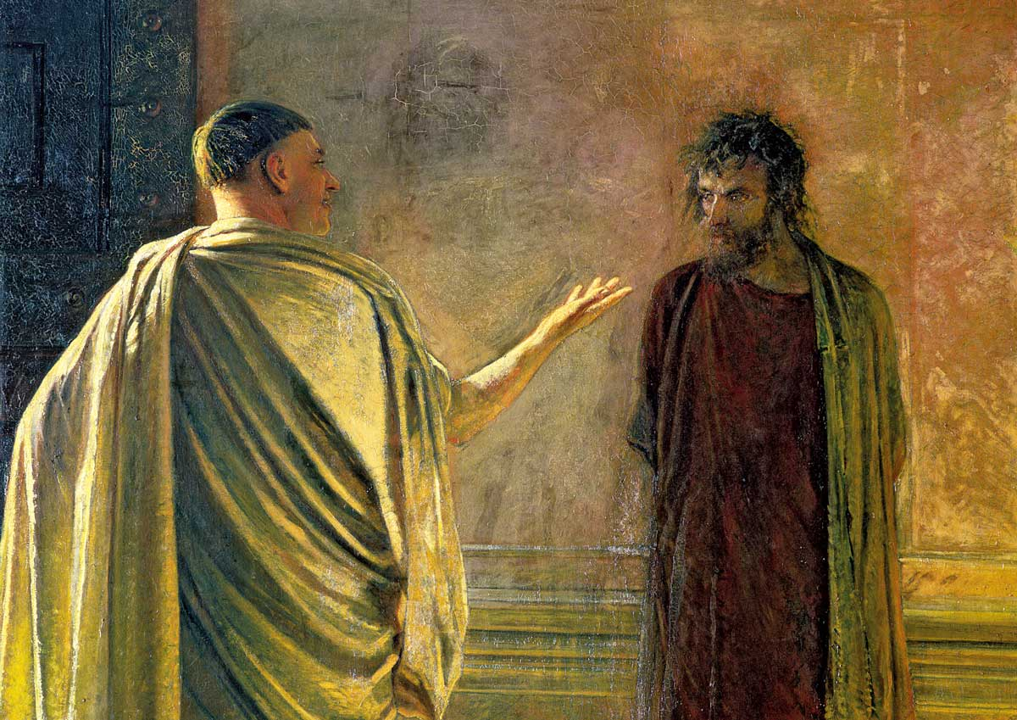
Jesus answered, “You say that I am a king. In fact, the reason I was born and came into the world is to testify to the truth. Everyone on the side of truth listens to me.”
“What is truth?” retorted Pilate.
As Roman Governor of Judea Pilate had to manage a region simmering with religious extremism and political tensions. All of this is in evidence in the narratives of Jesus’ trial before him.
Perhaps the only truth that mattered to Pilate was power. If you are able to kill or spare anyone you want, what does ‘truth’ really mean?
The Roman Empire was ruthless: its might was right and it crushed whoever threatened its control. But despite this, in order to keep imperial order Pilate had to play politics to manage local tensions. He wanted to avoid being embroiled in religious disputes but he also needed to manage the Jewish leaders, and the volatile crowd.
‘Archetypal politician’
In Easter 1996, a year before he would become Prime Minister, Tony Blair wrote these words in the The Sunday Telegraph:
“It is possible to see Pilate as the archetypal politician, caught on the horns of an age-old political dilemma. One can imagine him agonising, seeing that Jesus had done nothing wrong, and wishing to release him. Just as easily, however, one can envisage Pilate’s advisors telling him of the risks, warning him not to cause a riot or inflame Jewish opinion…his is the struggle between what is right and what is expedient that has occurred throughout history.”
Blair’s words are fascinating to read in retrospect because his own legacy is dominated in many people’s eyes by his decision to invade Iraq on a flimsy pretext. To many he has been guilty of the same lack of principle that Pilate showed.
Looking at ourselves
It is easy to point at politicians and label them all as corrupt and deceitful. But perhaps we should ask ourselves, if we were in their position, would we do any better?
Consistently telling the truth is something we all find difficult.
Like politicians, we often want to protect ourselves and our reputations, and provide our own ‘spin’ on events that we are involved in. We also fear consequences when we get embroiled in complicated situations. We also want to present ourselves positively on social media. And often, we don’t say what we mean because of the conflict and controversy it might cause. Often ‘being nice’ is a lot easier than being honest.
Inseparable
In the first chapter of John’s gospel, Jesus is described as coming from the father ‘full of grace and truth’. In Jesus’ actions and teachings. his grace and truth are inseparable. His grace is full of truth and his truth is full of grace.
Take the woman caught in adultery who is being threatened with being stoned (John 8). Jesus tells those who are without sin to cast the first stone…and everyone walks away. He speaks with grace when he says ‘Then neither do I condemn you’ but adds the truth ‘Go, leave your life of sin.’
The prodigal son (Luke 15) is a story of grace because when the errant son returns home he is embraced and restored into the family. But before then, the story describes how the son had to come to his senses, understand his wrong-doing and turn around and return. The Father’s embrace of grace follows his son’s embrace of the truth.
Costly grace
And most deeply of all, we see Jesus’ grace and truth in his death on the cross. Jesus’ sacrificial death was an act of grace – to offer forgiveness to all. But he does this by confronting the sinful reality of the world with his truth.
Grace without truth is cheap and changes little. But the world’s sins are dealt with on the cross because of the costly grace of God. Sin was confronted and death was defeated.
And the truth unleashed at Calvary has changed the world forever. Just consider how we view the cross itself: transformed from the cruelest instrument of death to the most powerful sign of hope ever known.
Ultimate truth-teller
The Bible records over 80 times when Jesus says the words ‘I tell you the truth’. He never buckled to pressure like Pilate, never compromised , went with the flow or failed to bear witness to God’s love for all. Jesus is the ultimate truth-teller.
2000 years on, Pilate’s question ‘What is truth?’ is one that still needs answering. We live in a world dying for a deeper truth to life by, a firmer foundation to build our lives on.
And it is in the person standing before Pilate that we find the truest and deepest answer to his question. Jesus, the rejected and despised one, is the clue to understanding all history.
He is the way, the truth and the life. He is truth that can set us free.
Based from a sermon I gave at Streatham Baptist Church. Watch here starting at 3.55:
Discover more from Grace + Truth
Subscribe to get the latest posts sent to your email.

 Grace + Truth
Clear and effective look at Pilate the politician. It relates so well to how it is impossible to please everyone all the time. For every decision, the answer must be to think, “What would Jesus do and say in this situation?”
LikeLike