This is the text of a talk given at Streatham Baptist Church on 23-11-25 in the sermon series A Better Story. It is also available to watch on video at the bottom of the text.
About 15 years ago when I was driving in south London and I stopped at traffic lights. My son Tom who was 5 years old at the time, said to me
‘Dad, what’s a marital affair?’
I wondered what he was reading or what he had been hearing in the playground. But he was pointing to this massive billboard on the junction for a website called Marital Affair with this image, promising ‘instant excitement’.

I couldn’t believe there was this huge advert promoting a website encouraging people to be unfaithful to their partners. When I got home, I contacted the local council and they sent me to the Advertising Standards Authority where I lodged a complaint.
And a few days later I got a reply – it basically to reject my complaint – they said:
“We can only act if the ad offends against widely accepted moral, social or cultural standards. This advert was unlikely to cause serious or widespread offence or be seen as irresponsible.”
Fundamentally, I strongly disagreed with this response. I did find the billboard offensive, and I definitely thought it was irresponsible.
So I started a Facebook group to see how many people agreed with me. And quickly I realised it was a lot of people. Some were angered by the attack on families, others sickened by a company making money from turning unfaithfulness into a commodity.
I thought about 20-odd people might agree with me but after the first day I had over 300 and a few days later it grew to over 1500. And these people were up for up for some direct action.
We found out that it was a big company called Global Personals behind the website and its founder and CEO was a high-profile millionaire. So we encouraged people to drop him an email explaining why they disliked the advert and emphasised the need to be polite and reasonable and not to be angry or abusive.
|The CEO didn’t like it and after a few hours he phoned us and asked us to stop the emails. We said we would, if he withdrew the advert.
By this time, the campaign was getting noticed – we had coverage on Sky News, the Daily Telegraph and many other websites. Lots more people were getting involved with over 4000 now part of the group.
So the next day, we asked our followers to phone the Global Personals offices and calmly, politely and graciously explain their experiences of unfaithfulness and their concerns about their business. They got hundreds of calls and it took just one day of that for them to issue the following statement:
“We have reviewed our advertising strategy and have instructed our agency to remove billboard ads from our current campaign in light of recent developments.”
Our campaign succeeded – and the advert was withdrawn.
The campaign led to some funny things. Later, I was invited to speak at a conference in Las Vegas on ethics in online dating – which I had to turn down as I knew nothing on this subject. But there was also tough times, when I received a very threatening 5 page legal letter designed deliberately to intimidate and to silence us.
And of course, this little campaign hardly changed the world – but it was a sign or a small example that people can do something to challenge wrong. A mustard seed or a trace of yeast that can work through the whole batch. As the famous quote goes:
“Never doubt that a small group of thoughtful, committed citizens can change the world; indeed, it’s the only thing that ever has”
I wanted to share that story because its an example of recognising and resisting the deceitful stories that we are surrounded by – and fighting with not with aggression but with a better story of grace and truth.
And the first 2 letters of our sermon series are relevant because rather than a Better Story, we are often surrounded by BS – the bullshit we are constantly fed by media and advertising.

In the reading from Philippians, Paul uses a similar term:
“I have lost all things. I consider them garbage, that I may gain Christand be found in him”
What is translated in our translation as garbage or rubbish, is actually closer to dung or excrement.
I think we need to consider the materialist, consumer culture around us as excrement – especially and the advertising which promotes discontent, tells us lies and tempts us. It is like toxic waste that endangers our soul and true well-being.
And this advert and the website it promoted was a prime example of the BS that surrounds us. The messages that this ad sent out was
- That faithfulness doesn’t matter
- That life is about looking after Number One
- That your choice is more important than commitment
- That you can have sex with no strings attached
But these things are not true – they are BS. In the real world, we see the consequences of unfaithfulness all around us – in broken families and broken lives. I spent years working with young people who had become homeless whose lives have been shattered by family breakdown and the neglect of their parents.
And in this campaign I saw the dark heart of businesses who have no morals. I was sent threatening letters by the company’s law firm designed to intimidate and met with them at their chambers in Temple Court in London. Behind the flash offices, expensive suits and clever brains there was a complete vacuum of morality. We need to reject the BS that says:
- That money and power is everything
- That there is no truth, everything is relative
But also the criticisms I got during that campaign taught me about rejecting other messages – things like:
- That you cannot make any difference
- That you should just play it safe and not take any risks
But taking risks is fundamental to having faith – it’s how we grow in dependence on God. If we don’t take any risks for what we believe, how much do we actually believe it?
The Better Story of grace and truth
In contrast to that kind of BS – There is a Better Story and grace and truth are at the heart of it.
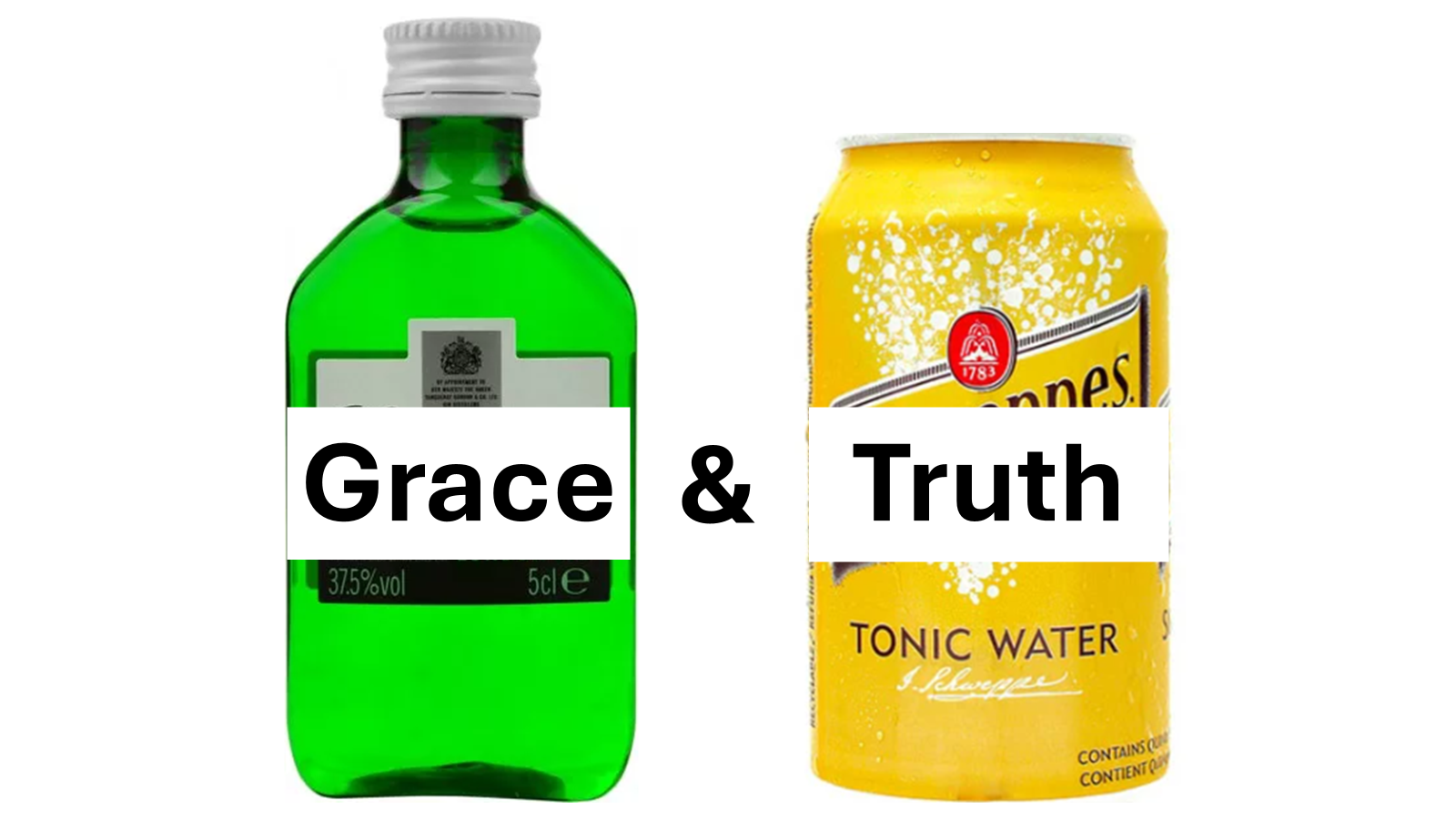
Grace and truth helps avoid these 2 polarities:

- Harsh judgement – when we are so sure that we are right that we look down on others, hard edged and unforgiving – where there is no grace, no tolerance, no understanding. We all know Christians like this.
- Woolly relativism – where everything is viewed as subjective and down to individual choice and we lose hold of objective truth. Tolerance which goes so far that there is no foundation to speak from – no distinctiveness of belief.
Neither is the message the world is waiting for, or can can give us what we truly need – and neither reflects the way of Jesus.
Jesus came from the father, full of two qualities: grace and truth.
The grace of Jesus
Jesus embodied grace through what he taught and how he lived.
He told stories of grace – a rebellious son who wasted his father’s fortune but was greeted home with a party rather than a punishment.
The Samaritan foreigner who risked his life to care for another across the racial and religious divides.
The landowner who pays all the workers the same rate of pay how ever many hours they worked.
He spoke of those who were considered the least in his society actually coming first in God’s estimations. Poor widows whose gifts are worth more than the wealthy. poor beggars who go to be with God in heaven and rich people who end up in hell.
And Jesus’ example was even clearer: he choose those considered outcasts to join his group of followers, by touching those considered unclean, by breaking the religious codes to heal the disabled and help them re-join the community.
Though innocent, Jesus went to his death as a sacrifice for all – and even offered grace even to those who put him to death: ‘Father forgive them’.
Grace – God’s unearned love, forgiveness and acceptance is at the very core of this Better Story. Through Jesus, God has acted to redeem all people, to offer another chance to everyone to be a part of the new world that He is creating. Grace is the best thing Christians have to share.
And if you are here and you are struggling this morning, perhaps this is grace is what you need to hear from Jesus and embrace for yourself: you are forgiven, you are loved, you can be restored.
The truth of Jesus
But on the other hand, it would be wrong to portray Jesus as mild, uncritical and nice. His spoke with a sharp edge of truth about the need for radical change:
‘I tell you the truth, no one can see the kingdom of God unless he is born again’.
28 times in John’s gospel alone he begins sentences with the phrase ‘I tell you the truth…’
Jesus told his disciples that his message would bring conflict and division:
‘I did not come to bring peace, but a sword’.
Jesus describes himself as ‘the way, the truth and the life’ and taught with an authority it of objective truth – truth like solid rock you can build your life on. The crowds marvelled at this but the religious elite hated it.
But Jesus did not just have sharp words to those who opposed him but also to those who followed him, criticising his disciples for their fixation on status and shallow understanding of his work.
Synthesis
So in Jesus grace and truth are synthesised and cannot be separated.
In the story of the lost son, before he returned home, the wayward son needed to come to his senses. The embrace of grace he received was proceeded by his embrace of truth.
For the woman caught in adultery, Jesus does not ignore her wrong-doing but he does not condemn her. Grace is shown when he says ‘Then neither do I condemn you.’ But he also speaks truth: ‘Go now and leave your life of sin’. Change your life, live differently.
The way of Jesus is gracious truth and truthful grace: ‘Then you will know the truth and the truth will set you free’.
This is the message we all need: God’s grace – especially if you are struggling. Come to Jesus to find grace and let go of all the untruth you have been told or subjected to, as well as the self-deception and self-justifications which imprison you. Open your life to him, find forgiveness, restoration and new life.
Homelessness
I have spent the last 30 years working with people who are homeless work running hostels, day centres and housing services. And grace and truth is incredibly relevant to offering help.

Showing love to people who are homeless is not just about the left-hand side of this chart – its about doing both. Its made such a difference to me to be equipped with this thinking – helped me make good decisions, avoid burnout and make my work sustainable, root my work in my deepest beliefs about Jesus.
Perhaps this chart is relevant for you:
- Someone in your family – so relevant to parenting
- Someone you are married to. Being truthful has been so important for Nikki and I to keep our marriage healthy.
- Someone at work – a colleague or client who you need to have a courageous conversation with
- For yourself – being honest and truthful about the ruts you are stuck in, unhealthy habits, bad behaviour that you need to face
Bring these situations to God – receive his grace which helps us live a life of truth: to bring pain into the light, to leave a life of sin and find hope.
Your role in The Greatest Story
So as we end this series of a Better Story, let’s think about what this means for us.
The Better Story is not one to read or listen to – but to live out. What was the title of the course we did earlier in the year? Thinking about the way? talking about the way? singing about the way? No, it was Practising the Way.
For those who like a sporting analogy – we are not called to be fans who just watch the action from the stands or pundits who analyse from the studio. We are called to be on the pitch – to be players in the thick of the action.
I love Paul’s words are so personal:
“I want to know Christ – yes to know the power of his resurrection”
He wants to know more the power that rose Jesus from the tomb and which can transform lives today.
But what is the route to this? Its not just through study or singing or religious activity – its through participation – being involved in his sufferings, becoming like him in his death’.
This is so challenging – but it’s the way of the kingdom of God – the way of the cross. And its why we have the cross up here on the stage and not hidden away in a corner covered by flags. The cross is the place where Jesus suffered – but its also the place where he triumphed. It is the deepest place of grace and truth.
And the cross not just something that Jesus did for us – its something for us to pick up and carry for ourselves in our lives. We need to participate in Jesus’ example.
What role are you going to play? What will be your story in the coming years?
Participating in Jesus’ suffering means being involved in other people’s lives – living out his grace and truth. And the way we do this is through serving.
There is what we do at work but there are plenty of opportunities in church: the welcome team, AV and sound desk, Ichthus, Kingdom Kids, community activities, Friendly Club, Pre-School, The Vine, Girls Group. And this week we will be sharing a vision around a whole week of community activities next summer.
This is how each of plays a role in the Greatest Story ever told
Like all the best stories – is about love.
But not a soppy, sentimental form of love. A gritty, down to earth, cross-shaped form of love. A love that is full of grace and forgiveness. A love full of truth which stands up for what is right and challenges the BS we are surrounded by.
A love which has resurrection power. A love which we can participate in.
This is Better Story we have received – and this is the Better Story we can share.
 Grace + Truth