Revd Dr Al Barrett is Vicar of Hodge Hill Church, Birmingham. He has contributed to a new resource: Joy for All: Supporting churches to respond to the co-option of Christmas by the far right
The sharp end
People in my parish find themselves on the sharp end of national politics. Our area has been economically marginalised, ‘asset-stripped’ of vital public resources and jobs are increasingly hard to come by. We have historically ‘white working-class’ outer estate neighbourhoods which are now much more ethnically diverse, and over half the residents of our parish are Muslim.
We have a hotel that houses asylum-seekers in one corner of our parish that has had a number of ‘protests’ outside it in recent months, mostly made up of people who live nearby. And within our congregation we have both people of African and African-Caribbean heritage who experience racist language every day and feel threatened by the raising of St George’s flags, and people who feel ‘unmoored’ by the changes around them and long for a sense of stability they feel they’ve lost.
Robinson’s rally
At the centre of Christmas is the incarnation. That God becomes flesh in Jesus and breaks down the dividing walls between us, and draws all people, all creation, together.
But next week Tommy Robinson is holding a rally in central London which he claims is aiming to ‘put Christ back into Christmas’.
What do we do when we are faced with versions of the Christmas message that feel so contrary to this inclusive heart of our faith?
Tensions
Navigating the complexity and discerning a faithful response is by no means a straightforward task. It means grappling with these tensions:
We want to say No to hostility and division – but we also want to say Yes to flawed human beings, because that’s all of us.
We do want to challenge divisive messages, but we don’t want to unwittingly amplify them.
We do want to focus on the good news of the incarnation but we don’t want to avoid challenging or tacitly supporting messages which are contrary to the gospel.
We do want to offer a compelling counter-narrative, but we don’t want to turn this into a competition for attention, volume, numbers – because we’re working with a radically different theology of power.
We do want to ‘put Christ at the heart of Christmas’, but what we mean by that is very different to the aggressive ‘Christian nationalism’ emerging in our country.
We do want to affirm our solidarity with refugees and asylum-seekers, but we don’t want that solidarity to be turned into another polarised ‘us vs them’ division that means some of our neighbours hear that we’re not in any sense ‘for them’.
And we do want to listen to those drawn to nationalism in communities, to understand their ‘hopes and fears’ and help them know that these are met in Jesus.
The heart of Christmas
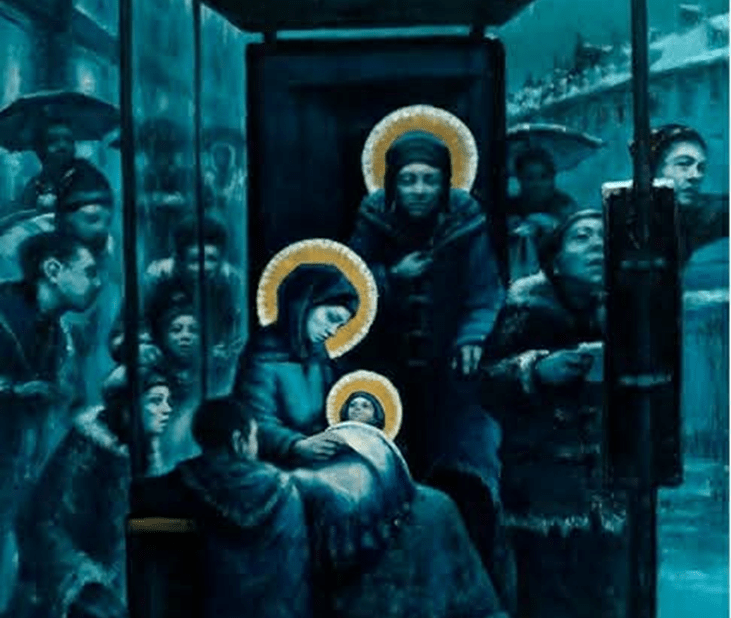
At the heart of Christmas is God’s power in all its fullness revealed in a baby: a small, defenceless, newborn child. It’s the starkest of contrasts with the violent power of King Herod and the Roman Empire behind him.
The nativity is a story big enough to welcome all who feel excluded and marginalised, whether they be ‘local’, low-status shepherds, or ‘foreign’ magi who have travelled from distant lands. The shepherds and the magi may not be able to speak the same language and have nothing in common, but they have been drawn to the same manger by the God of Love.
A different power
The Christmas story is profoundly political: but it embodies a radically different kind of politics. It invites us into a space where the ‘world order’ as we know it is turned upside-down and where our supreme loyalty is to the ‘law of love’ (of God and neighbour).
And amid the challenges, many of my deeply diverse neighbours can tell stories of strangers becoming friends, of difficult conversations and deep listening across political differences, and of working together to build community across dividing lines. And those of us who are Christians locally have been involved in this work precisely because we see the incarnation of God in Jesus at the heart of it all.
How we respond
So, how can we respond to the aggressive nationalism that’s making its voice heard in the lead-up to Christmas this year?
I suggest we need to make some careful distinctions:
Between the aggression of those on the stage with the microphones, and the crowd who might turn up to such gatherings.
Between the message which may include elements of divisiveness and hostility, and the people who are complex and flawed and made in God’s image, just like us.
Between racist behaviours of individuals, and structural racism embedded in our power structures that impacts lives and influences our thinking and relating.
Between the surface grievances such as hostility to asylum-seekers, and the deeper struggles of poverty, poor housing, over-stretched public services which call for deep listening, acknowledgment and concrete actions for justice.
Between Christianity (which is all about Jesus), and Englishness (which may or may not be important to us). The two have an entangled history in this country but are distinct.
Between the kind of power that is embodied in ‘them-and-us’ divisions and the desire for ‘strong-man’ might, and the power of God-in-Jesus, embodied in smallness, humility and vulnerable love
Once we’ve made those distinctions in our heads and hearts, then let’s shape our words, images, actions and interactions this Christmas in keeping with God’s love, hope, peace and joy.
A new resource for responding to Christian nationalism: Joy for All: Supporting churches to respond to the co-option of Christmas by the far right
Discover more from Grace + Truth
Subscribe to get the latest posts sent to your email.

 Grace + Truth
2 thoughts on “Responding to Tommy Robinson’s Christmas rally – by Al Barrett”