

We have a growing cultural problem that affects the world of work and much of the church: we don’t like being challenged by others.
Few of us want to go back to the days of aggressive bosses, stiff upper lips and stoicism. But the current cultural climate can mean we lack confidence in the vital task of giving and receiving feedback.
In the work place, employers face the possibility of their staff going off sick on mental health grounds if they are challenged. Parents and teachers trying to exert authority over teenagers can be answered with reference to human rights and threats to call ChildLine.
And those in pastoral ministry in church will often avoid conflict at all costs. Our desire for churches to be places of refuge can mean that arguments or tensions are considered a sign of spiritual failure.
Route to peace
In his letter to the early church in Thessalonica, Paul wrote:
“Acknowledge those who work hard among you, who care for you in the Lord and who admonish you. Hold them in the highest regard in love because of their work.” (1 Thess 5: 12-13)
Those who lead have to be prepared to intervene and ‘admonish’ others. It is a sign of health and the route to ‘living in peace’. As Gene L Green comments:
“While personal correction has become anathema in the church today, ancient opinion was that correction by others was profitable for a person’s wellbeing.’
‘Radical candor’
But how can we understand, experience and give challenge to one another in a way that is truly loving, respectful and constructive?
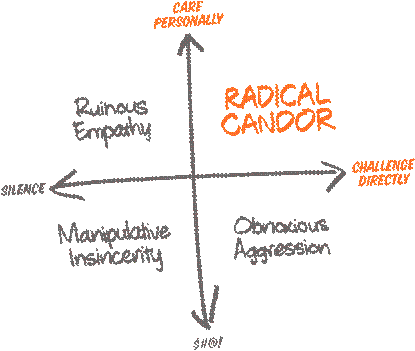
The American management expert, Kim Scott wrote the highly-regarded book Radical Candor (I’ll use the US spelling from now on) considering this question and developed this helpful quadrilateral:
The core theme of her book connects strongly to Jesus’ continual emphasis on grace and truth.
And to help those who like things a little less abstract, I have enlisted the help of some Mr Men characters to help explain what I think this means in practice…

Mr Worry’s Ruinous Empathy
On the top left of the quadrangle we find ourselves falling into the trap of Ruinous Empathy. So focused on personal care, grace and empathy, we allow ourselves to be subsumed by the experience of the other to the point that we lose objectivity.
Mr Worry desires grace without truth, the New Testament without the Old, Spirit rather than Word. As Jon Kuhrt continually argues on his Grace + Truth blog, it is lopsided to want appreciation without accountability, forgiveness without boundaries, compassion without justice, support without empowerment, always an empathetic ‘yes’ and never a compassionate ‘no’. Communities and work places do not work when we follow the maxim:
‘If you can’t think of anything nice to say, don’t say anything at all’.
Mr Worry is so worried about upsetting others that he never says anything. This fearful form of empathy does not help people or communities mature. Rather it spoils them and leads to churches and communities that may be rich and comfortable but lack purpose or vision.

Mr Nosey’s Manipulative Insincerity
Mr Nosey gets overly involved in others people’s business. But he does not really care for the person, nor for the truth. His demonstrations of care and sweet talking are cleverly crafted words in order to get his own way. He gossips and back stabs and will likely cause painful strife in a community, often without many realising.
Paul’s letters to the Thessalonians warn those that are idle because of their tendency towards gossip and trouble-making: ‘they are not busy; they are busybodies!’ (2 Thess. 3:11). Mr Nosey’s self-concern and manipulation is toxic to a church community.

Mr Uppity’s Obnoxious Aggression
On the bottom right the Mr Uppity’s are stuck in a loveless commitment to truth and correctness. He doesn’t really care how what we say goes down with the hearer. He leans towards law over grace, Old Testament over New, Word rather than Spirit. He is impatient with the weak and irritable with the failings of others.
He embodies accountability but no appreciation, boundaries without forgiveness, justice without compassion, and much prefers saying ‘no’ rather ‘yes’. Mr Uppity is an unrelentingly critical voice, who tends towards leaving the children of God battered and bruised.

Mr Good’s Radical Candor
However, in the top right corner we have what we should aim for: to speak with radical candor. To blend both grace and truth in how we interact with others.
This is the example of Christ: lovingly truthful and truthfully loving. His actions towards us are truly in our best interests. He embodies both Old Testament and New, Word and Spirit, justice and compassion, wisdom and discernment.
Rather than spoiling, neglecting or battering us, He nurtures us as a true Shepherd-King, combining gentleness and strength. He is patient with every one of us. He helps and empowers, cares and challenges, encourages and warns, says ‘Yes’ and ‘No’.
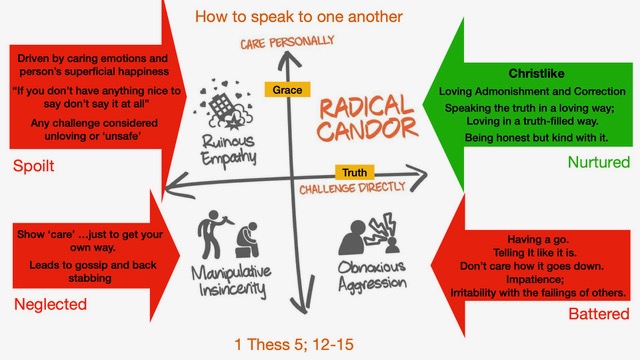
The ultimate Mr Good is Christ himself. And when we move towards His ways, we find a truth which sets us free and the children of God being nurtured into maturity: the church thriving and overflowing with truthful kindness. As Paul puts it:
“Warn those who are idle and disruptive, encourage the disheartened, help the weak, be patient with everyone. Make sure that nobody pays back wrong for wrong, but always strive to do what is good for each other and for everyone else.” (I Thess 5:14-15)
Which ‘Mr Man’ reflects the culture at your work? Why not share this article with colleagues to open up a discussion?
Anna Price is Community Strategic Manager at St Mary Magdalene Church Gorleston. She is passionate about how the extraordinary love of Christ can transform her, the church and their local community. Follow @magdalenechurchgorleston on Facebook.
Discover more from Grace + Truth
Subscribe to get the latest posts sent to your email.

 Grace + Truth
Thanks Anna. Lots of good insights here regarding management of people and giving feedback. Jesus is of course the perfect example of grace and truth as he is love incarnate. My only critical (but hopefully constructive!) feedback is that I think you should avoid characterising the Old Testament as ‘truth’ or ‘law’ and the New Testament as ‘grace’. If we understand the OT (the Hebrew Scriptures Jesus totally believed in) as Jesus did then we’ll see it is full of grace as well as truth. Likewise the New is full of truth as well as grace. The Jewish faith was never meant by God to be one of legalistic righteousness eventhough at that stage of salvation history there had to be laws from God to govern the religious and civic life of Israel (laws that did enshrine truth and grace). Of course some people do selectively cite certain OT passages when they want to emphasise ‘truth’ and some selectively cite certain NT passages when they want to emphasise ‘grace’ but both grace and truth are present in both testaments. Both testify to salvation by faith and God’s gracious love and forgiveness.
LikeLiked by 2 people
Hi Martin – thanks for this! I entirely agree with what you’ve said and am only sorry that didn’t come through. I was trying to pose many false dichotomies, OTvNT being one. Word v Spirit being another; Grace and Truth being another. True Grace and Truth are rich with the other. Does that help clarify?
LikeLiked by 1 person
I saw the article as showing Mr Worry and Mr Uppity as being the ones polarising between Old and New Testaments rather than the author! And I definitely have met plenty of people who do this.
As you both say, both Old and New weave grace and truth continually – I have been struck by the grace in the Psalms recently and by Jesus’ many ‘truthful’ injunctions and interventions.
But I do find in my daily reflections that one of the helpfulness of reading the Old Testament is that it lays a basis or a context into which Jesus’ outrageous grace shines all the brighter. So not to polarise but I do often turn to the gospels in relief from what I read in the Old. Jesus is ‘fuller’ of grace and truth than much of what we read in the Old Testament which is why he ‘fulfils’ scripture and shows God most fully.
I love Michael Ramsey’s line ‘God is Christlike and in Him no un-Christ-likeness is found’
LikeLike
Yes, that really helps. I understand now that you were listing false dichotomies. Thanks Anna.
LikeLiked by 1 person